儜
Character Story & Explanation
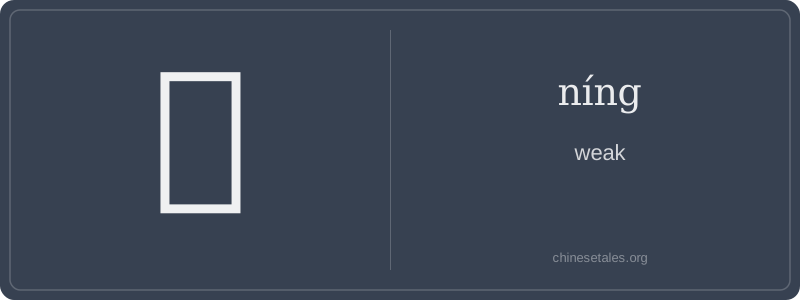
The earliest trace of 儜 appears in seal script (zhuànshū), not oracle bones — it’s too late for that. Its left side is the 人 (rén) radical — but transformed into 亻, the 'person' indicator — signaling human-related qualities. The right side is 寧 (níng), which originally depicted a person (宀 roof + 心 heart + 皿 vessel) under shelter, meaning 'tranquil', 'at peace'. Over centuries, 寧 was simplified and fused: its upper 宀 became -like, and the lower part condensed, eventually forming the distinctive right half of 儜. Visually, it’s a person (亻) leaning into tranquility — but paradoxically, that calmness curdled into fragility.
This semantic shift happened during the Six Dynasties period (3rd–6th c. CE), when literati prized ethereal delicacy — think pale skin, slender frames, sensitive nerves — as marks of refinement. 'Tranquil' (寧) began implying 'too tranquil to resist life’s roughness', hence 'frail'. By the Tang, 儜 appeared in poetry by Li He and others to describe moonlight 'so thin it trembles' or scholars 'whose bones hum with quiet exhaustion'. Its form — a person tethered to stillness — became a visual metaphor for vulnerability masked as serenity.
Let’s get real: 儜 (níng) is a linguistic ghost — it’s in the dictionary, but you’ll almost never hear it spoken or see it written outside classical texts or scholarly footnotes. Its core meaning is 'weak', 'frail', or 'feeble', but not in the everyday sense of 'I feel weak after lunch'. Think more like 'constitutionally delicate' or 'ethereally fragile' — a poetic, almost archaic shade of weakness reserved for describing refined sensibilities, faint light, or crumbling ancient things. It carries a quiet, literary hush.
Grammatically, 儜 is almost exclusively an adjective, and unlike modern adjectives like 弱 (ruò), it rarely stands alone or takes degree modifiers (e.g., *very* 儜 sounds unnatural). Instead, it appears in fixed literary phrases or compound words — often paired with characters like 瘦 (shòu, thin), 骨 (gǔ, bone), or 风 (fēng, wind) to evoke fragility as an aesthetic quality. You won’t say '他很儜' — that’s ungrammatical. But you might read '儜瘦如纸' (níng shòu rú zhǐ) in a Tang dynasty poem describing a scholar’s pale, translucent frailty.
Culturally, 儜 is a reminder that Chinese has layers — like sedimentary rock — where older, more evocative vocabulary survives in elite registers while simpler terms dominate daily speech. Learners often mistakenly treat it like a synonym of 弱 or 虚 (xū), leading to stilted or comically overwrought sentences. The biggest trap? Assuming it’s usable in modern Mandarin at all. It’s not — it’s a relic you admire in museums of language, not a tool for ordering dumplings.