侪
Character Story & Explanation
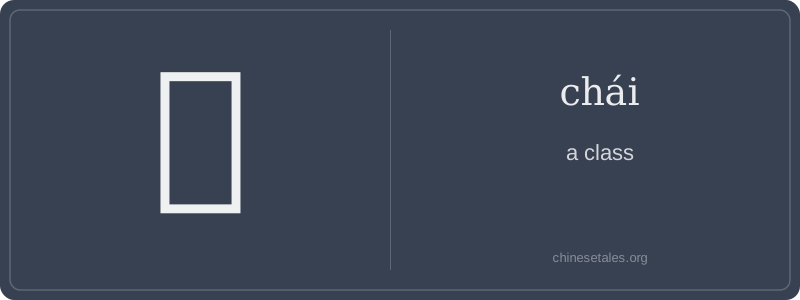
The earliest form of 侪 appears in Warring States bamboo slips — not as a pictograph, but as a phonosemantic compound: the left side 亻 (person radical) + the right side 齐 (qí), which originally depicted evenly aligned grain stalks in oracle bone script, symbolizing 'uniformity' or 'together'. Over time, 齐 simplified from three parallel lines with a base to today’s four-stroke form, while 亻 remained stable. The modern 侪 (8 strokes total) preserves that elegant balance: two strokes for the person, six for the 'evenness' — visually echoing its meaning: 'people aligned in status'.
This semantic logic crystallized in classical texts: in the Zuo Zhuan, 侪 appears in phrases like '与吾侪同列' ('ranked alongside my peers'), stressing parity in ritual hierarchy. By the Tang dynasty, poets used 吾侪 to evoke scholarly camaraderie — Du Fu wrote '吾侪醉后歌' ('We, fellow scholars, sing after drinking'), where 侪 subtly asserts shared learning, not just shared wine. Its visual symmetry — person + uniformity — remains its quiet manifesto: identity isn’t individual; it’s how you stand *in alignment* with others of your kind.
Think of 侪 like the Latin suffix '-es' in 'alumni' or 'media' — it’s a quiet, collective label that marks a group *by shared status or identity*, not just random people. It doesn’t mean 'people' (that’s 人 or 们); it means 'peers', 'fellows', or 'of the same class' — often with a subtle air of tradition, dignity, or even mild irony. You’ll almost never hear it in casual speech; it lives in literary phrases, formal essays, and classical allusions — like calling your colleagues 'my scholarly fellows' instead of 'my coworkers'.
Grammatically, 侪 is a noun or pronoun modifier, nearly always appearing in fixed expressions: as part of compound nouns (如 同侪), or after possessive markers (吾侪, 尔侪) meaning 'we (of this class)', 'you (of this kind)'. Crucially, it *cannot* stand alone — you’d never say '侪 went to lunch'. And unlike English 'class', it carries no socioeconomic judgment; it’s neutral-to-respectful, rooted in Confucian relational thinking about role-based belonging.
Learners often misread it as 'chái' (like 'chai tea') and assume it’s colloquial — but its sound is archaic, and its usage is deliberately elevated. Also, don’t confuse it with 群 (qún, 'crowd') or 辈 (bèi, 'generation'): 侪 implies *equality within shared standing*, while 群 suggests numbers, and 辈 stresses temporal cohort. Using 侪 where a native would say 同事 or 朋友 instantly flags you as quoting from a Ming dynasty essay — charming, but contextually jarring.