俦
Character Story & Explanation
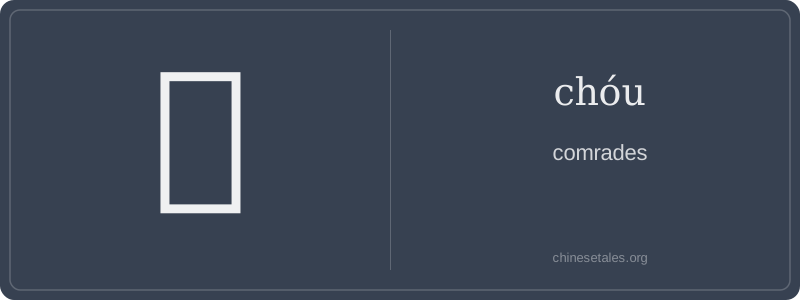
The earliest form of 俦 appears in seal script as a combination of 亻 (person radical) and 寿 (shòu, 'longevity'), but its oracle bone roots are murkier—some scholars trace it to a variant of 誰 (shuí, 'who?'), emphasizing relational identity. Visually, it evolved from a person (亻) beside a phonetic component (寿) whose strokes simplified: the top dot and horizontal line of 寿 became the two short strokes above the 'mouth' shape (口), while the lower 'hands' and 'tree' elements condensed into the final 九-like tail. By the Han dynasty, the modern 9-stroke structure stabilized—two strokes over 口, then 九 beneath.
This evolution mirrors its semantic journey: from a question of 'who stands beside you?' to an affirmation of 'those who stand *as your equal*.' In the Classic of Poetry, 俦 appears in lines praising virtuous rulers whose ministers were 'the finest of their kind'—not subordinates, but true peers. The 寿 component subtly reinforces this: longevity wasn’t just lifespan, but enduring moral alignment. So 俦 isn’t about proximity—it’s about resonance across time and virtue.
Think of 俦 (chóu) as the Chinese equivalent of 'comrades' in the old Soviet or revolutionary sense—not just friends, but peers bound by shared ideals, purpose, or station. It’s warm but formal, intimate yet dignified: you’d call your fellow scholars 俦, not your brunch buddies. Unlike the casual and all-purpose 朋友 (péngyou), 俦 implies parity—equal standing, mutual respect, often with a tinge of poetic or classical gravitas.
Grammatically, 俦 is almost never used alone; it lives in compounds (like 匹俦 or 无俦) or appears in literary set phrases. You won’t say 'my 俦'—instead, it’s embedded in structures like '与…为俦' ('to be peers with…') or '未有其俦' ('without equal'). Learners often mistakenly treat it like a noun they can pluralize or modify freely—but it resists that. It’s more like 'peerage' than 'pal': abstract, collective, and context-bound.
Culturally, 俦 carries echoes of Confucian relational ethics—where status, virtue, and reciprocity define human bonds. Mistaking it for a casual synonym of 'friend' risks sounding archaic or unintentionally lofty (imagine calling your roommate 'comrade' at a coffee shop). Also, watch tone: chóu (second tone) is easily mispronounced as chōu (first tone, 'to draw')—a slip that could turn 'fellow scholar' into 'pulling a rope'!