儓
Character Story & Explanation
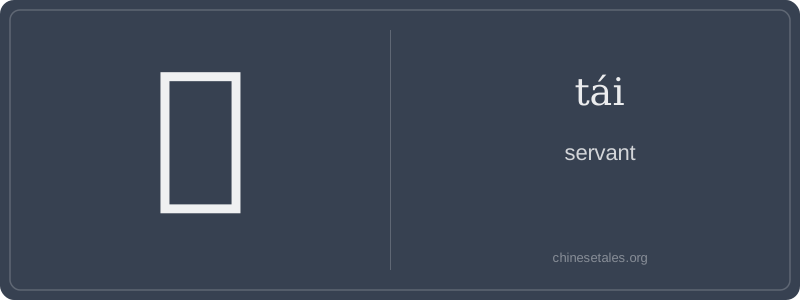
The earliest form of 儓 appears in Han dynasty clerical script, not oracle bone — it’s a relatively late creation. Visually, it combines the 人 (rén, 'person') radical on the left — simplified to 亻 — with 台 (tái) on the right. But don’t be fooled: 台 here isn’t the 'platform' character. In ancient phonetic loan usage, 台 served purely as a *sound hint*, borrowing its pronunciation (tái) while contributing no meaning. The left side 亻 anchors it firmly as a human role — literally 'a person whose function is defined by the sound tái'.
By the Tang and Song dynasties, 儓 solidified as a term for domestic attendants in elite households — distinct from slaves (奴) or guards (卒). It appears in Liu Zongyuan’s essays describing bureaucratic retinues and in Ming legal codes distinguishing 儓僕 (hereditary household servants) from hired laborers. Interestingly, its visual reliance on 台 — a character associated with elevation and authority — creates subtle irony: the 'tái-sounding person' serves *beneath* the platform. This quiet tension between sound and status makes 儓 a linguistic fossil of feudal semantics.
儓 is a literary, almost archaic character meaning 'servant' or 'attendant' — not the neutral 'employee' (员工) or modern 'staff' (职员), but someone in a clearly subordinate, often hereditary role within a household or official compound. It carries quiet dignity but unmistakable hierarchy: think of a well-dressed manservant in a Ming dynasty scholar’s residence, not a cashier at a convenience store. You’ll almost never hear it in spoken Mandarin today; it lives in classical texts, historical novels, and formal literary description.
Grammatically, 儓 functions as a noun, usually in compounds (like 儓僕 or 儓隸) or with modifiers (e.g., 老儓, 'elderly servant'). It rarely stands alone in modern usage — dropping it into casual speech like '我有个儓' would sound bizarre, even comically anachronistic. Instead, you’ll see it in descriptive phrases such as '儓僕如雲' ('attendants thronged like clouds') to evoke opulence and rigid social order.
Culturally, 儓 reflects pre-modern Chinese class structure — not just labor, but status-coded service. Learners often misread it as related to 台 (tái, 'platform') due to shared pronunciation and visual similarity, but there’s zero semantic link. Worse, some confuse it with 侍 (shì, 'to serve'), which is active and respectful, whereas 儓 is passive and positional — the one being directed, not the one directing. Its rarity means no HSK learner will encounter it on exams… but spotting it in a Tang poem or Jin Yong novel? That’s your secret handshake with classical fluency.