傤
Character Story & Explanation
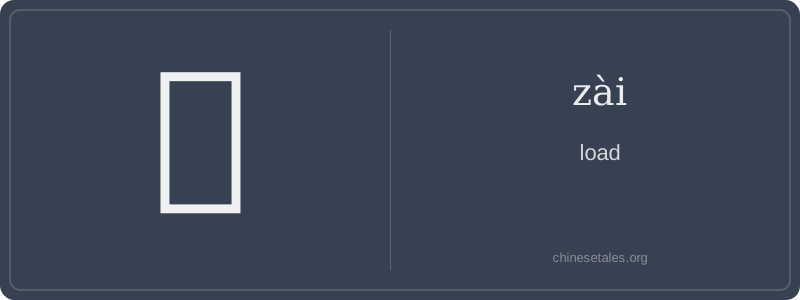
溯源而上, 傤 appears in early bronze inscriptions (jinwén) as a vivid pictograph: imagine a person (人) bent under a heavy burden — depicted as a curved line or box-like shape above them — with arms outstretched to stabilize the load. Over time, the ‘person’ simplified into 亻 (the ‘person’ radical), and the ‘burden’ evolved into a stylized component resembling (a variant of 戈, 'dagger-axe'), suggesting both weight and the act of securing cargo. By the Qin dynasty small seal script, the form had stabilized into 傤 — with 亻 on the left and a complex right-hand side combining elements of load, stability, and motion.
This character thrived in Warring States bamboo texts and early Han documents, often appearing in military logistics records ('three chariots 傤 grain') or ritual texts describing ceremonial offerings carried to altars. But as calligraphy grew faster and writing surfaces smaller, scribes began trimming strokes: the intricate right-hand side of 傤 gradually condensed into the cleaner, more balanced 載 — retaining the 亻 and replacing the top with 十 (a crossbar for 'even distribution') and the bottom with 車 (chē, 'cart'), making the meaning unmistakably 'to carry *by vehicle*'. By the Tang dynasty, 傤 was already archaic — preserved only by scholars copying ancient manuscripts, not by daily users.
Let’s get real: 傤 (zài) is a ghost character — it doesn’t exist in modern standard Chinese. You won’t find it in dictionaries, textbooks, or the HSK lists because it’s a historical variant, not a current character. Its core meaning *was* 'load' or 'to carry', but that role was fully absorbed centuries ago by its sleeker, more efficient cousin 載 (zài), which you *will* encounter — especially in formal or literary contexts like 載重 (zài zhòng, 'load-bearing') or 轉載 (zhuǎn zài, 'to repost/share online').
Grammatically, when 載 appears, it often functions as a verb ('to load/carry') or a noun ('a load'), and crucially, it’s one of those rare characters with two common pronunciations: zài (for 'load') and zǎi (as in 年載, nián zǎi, 'year after year'). Learners sometimes stumble by trying to use 傤 as if it were still alive — writing it in essays or flashcards — only to be gently corrected that it’s like using 'thou' in a Zoom meeting: historically meaningful, but functionally obsolete.
Culturally, this is a beautiful lesson in Chinese script evolution: characters don’t vanish overnight — they fade like ink on bamboo slips, replaced not by decree but by convenience. Scribes streamlined 傤 into 載 (replacing the top component with 戈 and refining the bottom), and the old form lingered only in ancient inscriptions and seal scripts. The biggest mistake? Confusing 傤 with 載 or even 來 (lái, 'to come') — visually similar at first glance, but worlds apart in usage and legitimacy.