儌
Character Story & Explanation
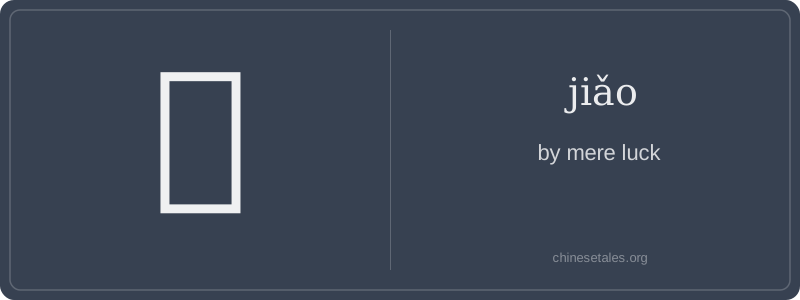
Carved onto Shang dynasty oracle bones over 3,000 years ago, the earliest form of 儌 resembled a kneeling figure (the radical 亻, 'person') beside a complex, angular symbol representing 'crossroads' or 'intersecting paths' — not literal roads, but the chaotic convergence of chance events. Over centuries, the 'crossroads' element simplified into the right-hand component 角 (jiǎo, 'horn' or 'corner'), while the person radical stabilized. By the Han dynasty clerical script, the two parts fused into the elegant, balanced structure we see today: 亻+角 — literally 'a person at a sharp, unpredictable turning point.'
This visual metaphor crystallized its meaning: fate’s sudden, unearned swerve. Classical texts like the Zuo Zhuan used 儌 to describe generals escaping ambushes 'by mere intersection of circumstances' — not skill, but the fortuitous alignment of fog, wind, and enemy error. The 'horn/corner' (角) wasn’t about aggression, but about a decisive, unforeseen pivot — like a deer spotting danger and veering sharply at a forest corner. Even today, the shape evokes that split-second, gravity-defying turn where logic ends and pure contingency begins.
儌 is a rare, literary character that whispers 'by sheer fluke' — not the cheerful luck of 幸运 (xìngyùn), but the breathless, almost guilty kind: when something absurdly improbable happens and you’re left muttering, 'I can’t believe I got away with that.' Its core feeling is precarious serendipity — like passing an exam after skipping every lecture, or finding your lost passport in the pocket of last winter’s coat. It’s never used for planned outcomes or sustained good fortune; it’s strictly for one-off, borderline-unbelievable breaks.
Grammatically, 儌 functions almost exclusively as an adverb, typically preceding verbs like 得 (dé), 遇 (yù), or 免 (miǎn). You’ll rarely see it alone — it lives in fixed, slightly archaic phrases like 儌幸 (jiǎo xìng) or 儌免 (jiǎo miǎn). Crucially, it *never* takes aspect markers (了, 过, 着) or reduplication — trying to say '儌儌' or '儌了' instantly marks you as a non-native. It also resists modern colloquial speech: no one says '我儌赢了!' on WeChat — they’d use 碰巧 (pèngqiǎo) or 好险 (hǎo xiǎn) instead.
Culturally, 儌 carries quiet moral weight — it implies the outcome wasn’t earned, so humility or even unease should accompany it. Confucian texts use it to underscore how undeserved favor demands gratitude and restraint. Learners often misread it as 嚼 (jiáo, 'to chew') due to visual similarity, or overuse it like a synonym for 'luckily,' missing its narrow, almost apologetic nuance. Remember: 儌 isn’t luck you celebrate — it’s luck you bow to.