儇
Character Story & Explanation
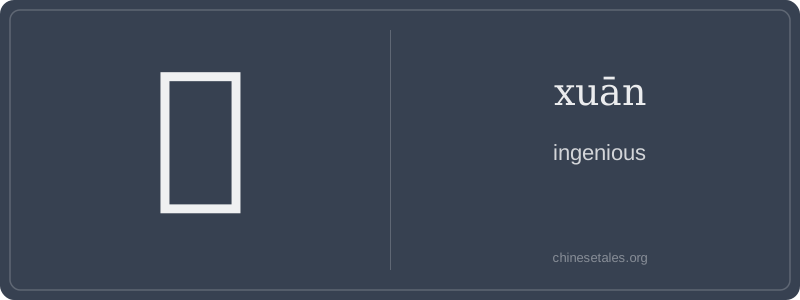
The earliest form of 儇 appears in Warring States bamboo slips, not oracle bones — and it’s a marvel of semantic layering. Its left side, 亻, was always the 'person' radical. The right side, 玄 (xuán), originally depicted a coiled thread or dark mystery in bronze script — think of a twisting black ribbon symbolizing profundity and subtlety. Over centuries, 玄 simplified from a looping glyph into three horizontal strokes + a hook, while 亻 stayed clean and upright. By the Han dynasty clerical script, the two sides fused into today’s balanced 15-stroke structure: a person grounded beside profound depth — literally 'a person embodying subtle insight'.
This visual logic shaped its meaning: 儇 wasn’t just 'smart', but 'insightful in a refined, elusive way'. In the Shuōwén Jiězì (121 CE), Xu Shen defined it as 'clever yet gentle, sharp yet restrained' — a rare dual emphasis. Tang poets like Li Bai used 儇 to describe lyrical ingenuity ('詞儉慧而意遠'), and Ming scholars praised '儉慧之士' — those whose brilliance shone through understatement, not argument. Even today, calling someone 儉慧 implies they grasp nuance faster than logic alone allows — like hearing the silence between musical notes.
Think of 儇 (xuān) as the Chinese equivalent of 'witty' in British English — not just smart, but quick, elegant, and slightly playful intelligence. It’s the kind of cleverness you’d praise in a poet who slips a double meaning into a single line, or a strategist who wins without raising a sword. Unlike common synonyms like 聪明 (cōngmíng, 'intelligent') or 机智 (jīzhì, 'quick-witted'), 儇 carries classical refinement and literary grace — it’s rarely used in casual speech, and almost never for children or machines. You’ll find it mostly in written descriptions of people, writing, or ideas: 'a 儇 mind', 'a 儇 remark'. It’s an adjective that *only* modifies nouns directly — no adverbial -ly form, no verb usage, no reduplication.
Grammatically, 儇 behaves like a literary stative adjective: it appears before nouns (儉慧之才), after 是 (shì) in judgments (他是儉慧之人), or in parallel four-character phrases (儉慧過人). Learners often mistakenly use it like 聪明 — trying to say 'I am 儇' (× 我很儉慧) — but that sounds jarringly archaic, like saying 'I am erudite' at a coffee shop. Instead, it’s reserved for elevated contexts: biographies, literary criticism, or formal praise. You won’t hear it on WeChat; you’ll see it in Tang dynasty poetry anthologies.
Culturally, 儇 evokes the Confucian ideal of wisdom tempered by elegance — intelligence that doesn’t blare, but glimmers. A common error is misreading its radical: though it has 亻 (person), it’s *not* about social behavior (like 仁 or 信), but about innate mental acuity. Also, its tone (xuān, first tone) is easily confused with xuǎn (select) or xuàn (show off) — but 儇 never means 'to choose' or 'to flaunt'; its brilliance is quiet, self-contained, and deeply traditional.