儆
Character Story & Explanation
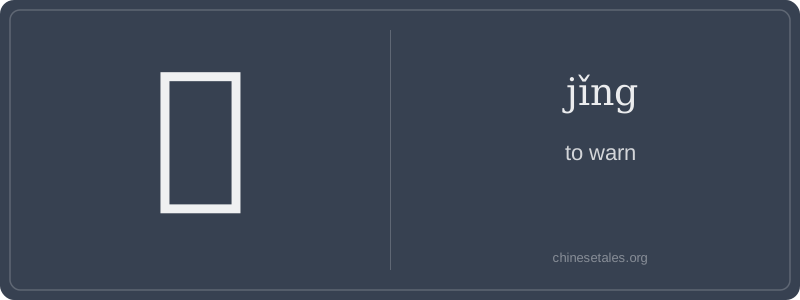
The earliest form of 儆 appears in bronze inscriptions (c. 1000 BCE) as a combination of 人 (person) and 敬 (jìng, ‘to reverence’), but crucially — with the left radical 亻 already present, and the right side evolving from a kneeling figure holding ritual wine vessels, symbolizing solemn, ceremonial observance. Over centuries, the right component simplified from 敬’s full form (gong + gong + 攴) into the modern ‘敬’-derived shape, losing its wine vessel but keeping the sense of ‘reverent attention’. By the Han dynasty, the character stabilized at 14 strokes: two for 亻, twelve for the intricate right half — every stroke reinforcing seriousness, not speed.
This visual solemnity shaped its meaning: from ‘reverent observation’ in early texts like the *Book of Rites*, it hardened into ‘warning by example’ by the Warring States period. In Sima Qian’s *Records of the Grand Historian*, 儆 appears when describing how Duke Wen of Jin executed a corrupt official ‘以儆效尤’ — to warn others against imitation. The character’s very structure — a person (亻) standing before a complex, weighty ‘敬’ — mirrors its function: a human acting as a living moral signpost, demanding respect before danger.
Think of 儆 (jǐng) as China’s ancient ‘amber alert’ — not a siren, but a solemn, ceremonial warning etched into stone and statute. Unlike the casual ‘be careful!’ vibe of 小心 (xiǎo xīn) or the bureaucratic ‘notice’ of 通知 (tōng zhī), 儆 carries moral gravity and authoritative intent: it’s the kind of warning issued by a ruler to deter crime, or by history itself to caution future generations. You’ll almost never hear it in daily chit-chat; it lives in formal writing, classical allusions, and legal-moral discourse — like saying ‘let this serve as a stark admonition’ rather than ‘hey, watch out!’
Grammatically, 儆 is almost always used in the compound form 警儆 (jǐng jǐng) — yes, doubled! — or more commonly as part of set phrases like 以儆效尤 (yǐ jǐng xiào yóu), where it functions as a verb meaning ‘to warn (by making an example)’. It doesn’t take objects directly like English ‘warn someone’; instead, it’s embedded in classical syntactic frames with prepositions (以, 为) and purpose clauses. Learners who try to say ‘I 儆 you’ will sound like they’re quoting a Ming-dynasty edict — charming, but wildly out of place.
Culturally, 儆 is inseparable from Confucian and Legalist ideas of exemplary punishment: punishing one person not just for justice, but as a public lesson. That’s why it’s often paired with words like 效尤 (‘imitating wrongdoing’) — the whole point is deterrence through visibility. A common mistake? Assuming it’s interchangeable with 警 (jǐng, ‘alert’). But while 警 is broad and modern (police, alarm, vigilance), 儆 is narrow, archaic, and morally charged — like confusing ‘sermon’ with ‘siren’.