儅
Character Story & Explanation
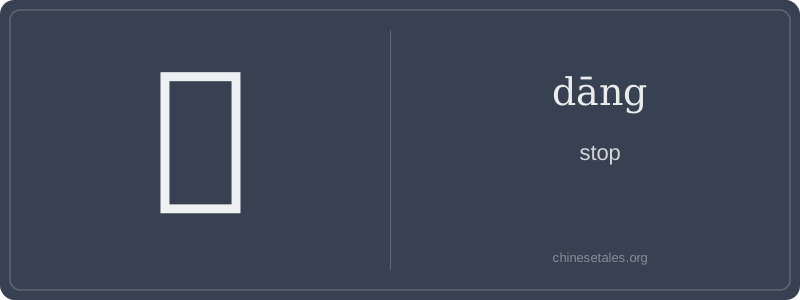
The earliest known form of 儅 appears in late Warring States bamboo slips — not oracle bones, but close! It began as a person radical (亻) standing firmly beside a simplified representation of a barrier: originally two parallel horizontal strokes (like a fence), later evolving into the top component 丨+一+一 (a vertical line flanked by two horizontals), symbolizing something solid placed across a path. Over centuries, clerical script added flourishes, and the lower part stabilized into the 'stop' component (丷+口), where the inverted 'v' (丷) suggests closure and the mouth (口) represents the bounded space being sealed off — a visual metaphor for 'halting passage at a threshold.'
This imagery resonated deeply in early Chinese cosmology: blocking wasn’t just physical — it was ethical. In the Zuo Zhuan, officials are praised for 儅邪 (dāng xié) — 'stopping evil' — where the character’s structure mirrors the idea of a virtuous person (亻) actively placing themselves as a moral barrier. By Tang dynasty poetry, 儅 appears in lines like '儅关莫笑一夫当关' — echoing the famous 'one man at the pass' trope, where the character’s rigid, upright shape evokes both the guard’s stance and the impassable mountain gate he defends. Its visual austerity perfectly matches its semantic gravity: no frills, just presence and prohibition.
Let’s cut through the noise: 儅 (dāng) is a rare, literary character meaning 'to stop' or 'to block' — not the everyday 'stop' you’d use at a red light (that’s 停 or 止), but the kind of forceful, deliberate halting you’d see in classical poetry or formal proclamations. Think of it as the verbal equivalent of slamming a heavy wooden door shut: decisive, physical, and slightly dramatic. Its core feeling is *interruption with authority* — often implying resistance to motion, influence, or even fate.
Grammatically, 儅 functions primarily as a transitive verb, almost always followed by an object (e.g., 儅路 — 'block the road'), and appears most frequently in fixed expressions or compound verbs rather than standalone sentences. You won’t hear it in casual speech ('Wait!' is 等一下, not 儅一下!), but you’ll spot it in written contexts like historical novels (‘他儅住叛军去路’ — 'He blocked the rebels’ path') or bureaucratic notices ('儅即处理' — though note: this is actually a common misreading; the correct form is 当, not 儅 — more on that in the 'similar' section!). Learners often mistakenly substitute it for 当 (dāng/dàng), especially in handwriting, because they look nearly identical — a classic 'inkblot trap'.
Culturally, 儅 carries a faint air of archaism and moral weight — in classical texts, it sometimes implies stopping something *unjust* or *dangerous*, giving it a subtle righteous edge. A frequent learner pitfall? Assuming it’s interchangeable with 挡 (dǎng), which *does* mean 'to block' and *is* common — but 挡 is phonosemantic (hand radical + dang sound), while 儅 is purely semantic (person + stop), and its usage is restricted to high-register, literary, or dialectal contexts. Using 儅 instead of 挡 in modern speech sounds like quoting Confucius at a coffee shop — charming, but confusing.