儃
Character Story & Explanation
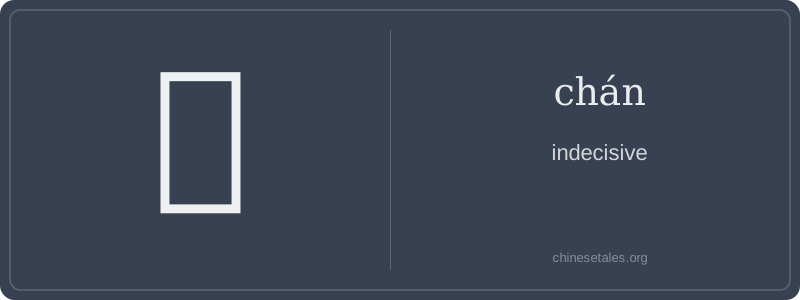
There’s no oracle bone or bronze script for 儃 — it’s a late-comer, first appearing in Han dynasty bamboo slips and early dictionaries like the Shuōwén Jiězì. Its form combines the 'person' radical 亻 (left) and the phonetic component 單 (dān, 'single, simple'), but here radically altered: the top of 單 became 口 (mouth), then evolved into what looks like 丷 + 日, while the bottom simplified from 口 + 田 to a compact shape. Stroke by stroke, it lost its pictographic roots and became a purely phonosemantic compound — the person radical hints at human behavior, while 單 (now silent in pronunciation) subtly suggests 'singularity' — paradoxically, the state of being trapped in one unresolved choice.
The meaning crystallized during the Six Dynasties period, when literati used 儃 to describe the psychological stillness of scholars contemplating fate or moral dilemmas — not weakness, but depth. The Wényuàn Yīnghuá, a Tang anthology, cites lines like '儃佪于中路,心若悬旌' ('lingering on the road, heart like a banner flapping in wind') — showing how 儃 implies motionless movement, thought without resolution. Visually, the character’s asymmetry — narrow left, broad right — mirrors imbalance itself: the mind leaning but refusing to tip.
Let’s cut through the fog: 儃 (chán) isn’t just ‘indecisive’ — it’s the quiet, almost physical *hesitation* that freezes you mid-step, like hovering your finger over two buttons on a remote. It evokes mental paralysis, not mere doubt — think of someone staring at two identical doors, unable to choose which to open. In classical Chinese, it often appears in compound adjectives like 儃儃 (chán chán), reduplicating the sense of lingering uncertainty, and it almost never stands alone as a verb or noun in modern speech.
Grammatically, 儃 is nearly always found in literary or poetic contexts — never in daily conversation or HSK materials — and functions almost exclusively as an adjective modifying nouns or verbs (e.g., 儃儃之态: 'a demeanor of profound indecision'). You won’t say 'I am 儃' — instead, you’d describe a *state*: '他站在路口,儃儃不前' ('He stood at the crossroads, frozen in hesitation'). Learners mistakenly try to use it like 犹豫 (yóuyù), but 儃 carries heavier, more visceral weight — less 'thinking it over', more 'spiritually stuck'.
Culturally, 儃 echoes Daoist and Zhuangzi-esque themes of suspension between opposites — not confusion, but a kind of sacred pause before action. That’s why it’s rare in spoken Mandarin: modern life demands decisions; classical philosophy honored the stillness *before* them. A common mistake? Confusing it with 蟾 (chán, 'toad') — same sound, totally unrelated meaning and origin. Pronounce it slowly: ch-á-n, like 'chaan' with a soft, drawn-out breath — mirroring the character’s own lingering quality.