侬
Character Story & Explanation
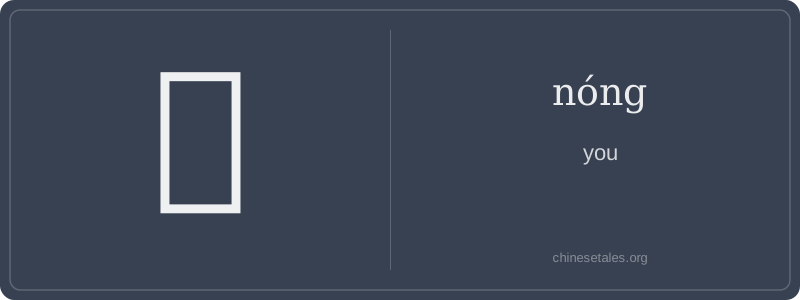
The earliest form of 侬 appears in Tang dynasty variant scripts, not oracle bones — because it didn’t exist back then! It evolved from the classical pronoun 恁 (nèn), meaning 'you (plural or honorific)', which itself derived from the demonstrative 那 (nà, 'that'). Scribes in the Jiangnan region began simplifying 恁 by dropping the 心 (heart) radical and keeping the 人 (person) and 农 (agriculture) components — but over centuries, 农 was further stylized into the elegant, flowing 1–2–3–4 stroke curve we see today. The left-side 亻 (person radical) anchors it as human-centered, while the right side, though now abstract, echoes the dense, rhythmic strokes of rural life — evoking villagers addressing one another across paddy fields.
This character wasn’t in the Kangxi Dictionary as a standalone pronoun — it entered written vernacular only around the Ming-Qing transition, flourishing in Wu folk songs and late imperial novels like *The Sing-song Girls of Shanghai*. Its visual softness (no sharp angles, rounded final stroke) mirrors its linguistic role: tender, familiar, unguarded. Even today, seeing 侬 on a Shanghai café sign — '侬好咖啡' — feels like hearing a lullaby in dialect: gentle, rooted, quietly defiant of Mandarin uniformity.
Think of 侬 like the French 'tu' — warm, intimate, and regionally charged. It means 'you', but not the polite, universal 你 (nǐ). Instead, 侬 is the cozy, slightly old-fashioned 'you' of Shanghai, Suzhou, and other Wu-speaking areas — like calling your childhood best friend 'babe' instead of 'you'. It’s rarely used in formal Mandarin, and never in official documents or national media. If you say 侬 in Beijing, people might smile politely and reply in standard Mandarin — or gently correct you!
Grammatically, 侬 behaves like a subject pronoun (e.g., 侬好 = 'You’re well?'), but it can also appear in possessive forms (侬个 = 'your', as in 侬个手机) and even object position in dialect poetry. Crucially, it *never* takes the grammatical particles that 你 does — no 你呢? or 你吗? You won’t hear 侬呢? in authentic Wu speech; it’s just 侬好? or 侬去哪? — clipped, melodic, and particle-free.
Culturally, 侬 carries a whiff of literary nostalgia and local pride. Older Wu opera singers use it; modern Shanghainese pop lyrics sprinkle it for charm ('侬是吾的太阳' — 'You are my sunshine'). Learners’ biggest mistake? Assuming it’s interchangeable with 你 — a slip that sounds either charmingly retro or jarringly out-of-place, like quoting Shakespeare at a Zoom meeting. Also: never write 侬 in an HSK essay — it’s a dialect treasure, not a textbook tool.