僿
Character Story & Explanation
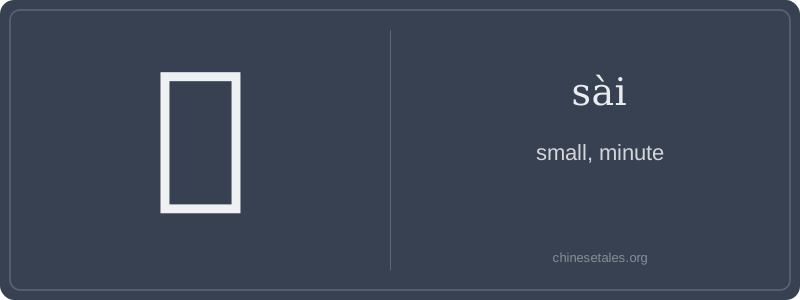
The earliest form of 僿 appears in late Warring States bamboo slips — not as a pictograph, but as a deliberate *graphic compound*: left side 亻 (person radical) + right side 塞 (sāi, 'to block'). Scribes added the 亻 to emphasize *human-scale minuteness* — not cosmic smallness, but the kind of tiny aperture a craftsman might drill, or a scholar might note in a scroll margin. Over centuries, the right component simplified from 塞’s full 13-stroke form to its current condensed shape, while the 亻 retained its upright posture — like a scribe standing attentively beside a microscopic detail.
This origin explains why 僿 never means 'tiny thing' outright, but always implies *a smallness requiring human attention or intention*: a pinhole in silk embroidery, a flaw in jade, the faintest ink trace in a master’s sketch. The Shuōwén Jiězì (121 CE) classifies it under 人部, defining it as '細微而可察者' — 'minute yet perceptible'. By the Tang dynasty, poets used it to describe dewdrops on spiderwebs (‘僿露懸絲’); in Ming pharmacopeias, it denoted particle size in powdered herbs. Its meaning didn’t shrink — it *focused*.
Imagine you’re reading an ancient herbal manuscript under candlelight, and you come across the phrase '僿粒如芥' — describing medicinal powder so fine it resembles mustard seeds. That’s 僿 in action: not just 'small', but *exquisitely minute*, almost imperceptible — a poetic, literary weight that ordinary words like 小 or 微 can’t carry. It evokes precision, delicacy, and antiquity, like measuring dust motes in a sunbeam.
Grammatically, 僿 is almost exclusively an adjective used in classical or highly stylized modern contexts — never in casual speech or beginner textbooks. You’ll find it after nouns ('僿孔', '僿文') or in fixed four-character phrases ('僿不可察'), but never as a standalone predicate (*'This is 僿' is ungrammatical). Unlike 小, which takes measure words freely (一个小苹果), 僿 refuses them entirely — no '一僿个', no '僿儿'. Its usage is tightly bound to written elegance, not spoken fluency.
Culturally, 僿 is a linguistic fossil — preserved in medical texts, calligraphy critiques, and Daoist cosmology, where 'the smallest aperture' symbolizes the threshold between visible and invisible realms. Learners often misread it as 塞 (sāi) due to visual similarity, or force it into colloquial slots where it sounds jarringly archaic. Remember: if your sentence could appear in a WeChat chat, 僿 doesn’t belong there.