僾
Character Story & Explanation
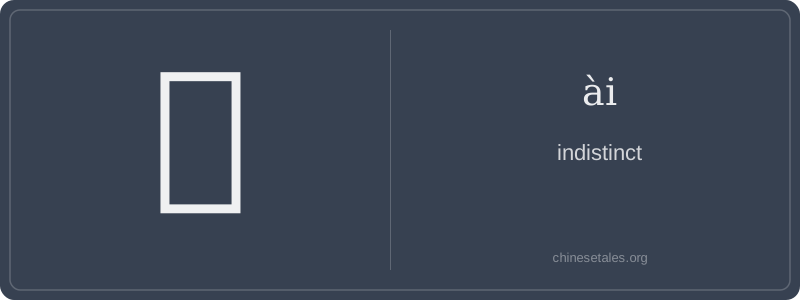
The character 僾 first appeared in bronze inscriptions of the late Zhou dynasty (c. 5th century BCE) as a compound pictograph: the left side was 亻 (rén, 'person'), while the right was originally 爱 (ài, 'to love') — but crucially, early forms show the top of 爱 written with 肙 (a variant of 冖, 'cover') over 夊 (suī, 'to walk slowly'), suggesting a person moving beneath a veil or shroud. Over centuries, the right component simplified and stylized into the modern 爱 shape, though the original semantic intent — 'a person obscured' — remained embedded in the form.
This visual origin directly shaped its meaning: from 'a person seen only dimly through mist or distance' to the abstract sense of 'indistinct perception'. By the Han dynasty, it appears in the *Shuōwén Jiězì* dictionary defined as 'invisible but perceptible — like breath or shadow', and later in Tang poetry (e.g., Li He’s lines about '僾然魂梦隔') to evoke haunting, liminal states between wakefulness and dream. The character never shed its aura of refined melancholy — it remains a lexical whisper, not a shout.
At its heart, 僾 (ài) evokes something just beyond clear perception — like breath fogging a cold window, or a memory half-remembered at dawn. It’s not mere 'vague' or 'unclear'; it carries poetic weight, suggesting presence felt but not quite grasped: a scent lingering after someone leaves, the ghost of a melody you can’t name, or sorrow so deep it blurs the edges of thought. Native speakers use it almost exclusively in literary, classical, or highly stylized contexts — never in daily chat or HSK-level textbooks — which is why learners rarely encounter it, yet feel startled when they do.
Grammatically, 僾 functions as an adjective or adverb, typically modifying nouns or verbs to convey elusive, atmospheric indistinctness. You’ll see it in phrases like 僾然 (àirán), meaning 'indistinctly visible', or 僾见 (àijiàn), 'to glimpse faintly'. Crucially, it’s never used predicatively ('It is ài') without a modifier — saying *‘这很僾’ is ungrammatical; it needs structure like ‘僾然可见’ or ‘僾然有思’. Learners often mistakenly treat it like common adjectives (e.g., 模糊 or 含糊), but 僾 resists that flattening — it insists on elegance and restraint.
Culturally, 僾 reflects a deep Chinese aesthetic value: the beauty of the unsaid, the power of suggestion over exposition. Think of ink-wash painting where mist obscures mountains — not to hide, but to invite contemplation. Confusing it with vague synonyms risks sounding either archaic to the point of parody or awkwardly out-of-place. Its rarity means every appearance is intentional — a quiet nod to classical sensibility in modern writing.