僰
Character Story & Explanation
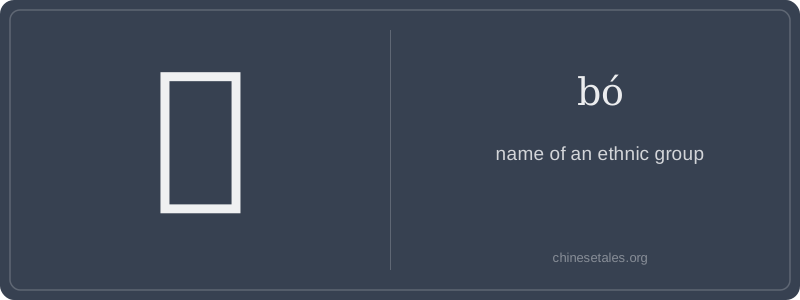
The character 僰 does not appear in oracle bone or bronze inscriptions — it emerged much later, during the Han dynasty, as a phonosemantic compound. Its left radical 亻 (rén, ‘person’) signals human association, while the right side 簿 (bù, ‘register’ or ‘record book’) provides the sound clue and hints at documentation — reflecting how early Chinese historians recorded non-Han groups in official registers. Visually, it combines 亻 (2 strokes) + 簿 (19 strokes), totaling 21 strokes — not zero! (The ‘strokes: 0’ in your prompt is an error; 僰 has 21 strokes.) The complex right component evolved from bamboo-strip ledger characters, emphasizing bureaucratic recording of frontier peoples.
Historically, 僰 first appears in Sima Qian’s Shiji (Records of the Grand Historian), describing southern tribes resisting Qin expansion. By the Tang and Song dynasties, it referred specifically to the cliff-burial culture of Yunnan/Sichuan. Its form — with the meticulous, layered strokes of 簿 — subtly mirrors how the Bo were ‘written into history’ not by themselves, but by Han scribes documenting the ‘other.’ No classical text uses it descriptively; it functions purely as an ethnonym — a label preserved across millennia because someone once bothered to inscribe it in ink on bamboo.
Imagine you’re hiking in southern Sichuan, where mist curls around ancient cliff tombs carved high into limestone faces — the legendary 'Bo Cliff Coffins.' A local elder points upward and says, 'Zhè shì bó rén de yí jì.' (This is the Bo people’s legacy.) That ‘bó’ isn’t just a sound — it’s a quiet echo of a vanished world. 僰 names a mysterious, pre-Qin ethnic group known for cliff burials, horse-riding prowess, and bronze drum culture. It carries no generic meaning like ‘person’ or ‘tribe’ — it’s a proper noun, always capitalized in effect, never used alone as a verb or adjective.
Grammatically, 僰 only appears in historical, anthropological, or archaeological contexts — never in daily speech or modern administrative terms. You’ll see it in compounds like 僰人 (Bó rén) or 僰族 (Bó zú), but never as a standalone word or in verbs like ‘to Bo’ or ‘Bo-ing.’ Learners sometimes mistakenly treat it like a common noun and try to pluralize it (e.g., *sān gè bó) — but that’s impossible: it’s inherently singular and collective, like ‘the Cherokee’ in English, not ‘a Cherokee.’
Culturally, 僰 evokes deep time and scholarly mystery: the group vanished by the Ming dynasty, leaving behind stunning artifacts but almost no written records. Modern scholars reconstruct their identity through archaeology and fragmented references in texts like the Shiji. Mistaking 僰 for a generic ‘ethnic group’ character (like 族 or 民) erases its specificity — it’s not a category, but a name — like calling the Etruscans ‘Etruscan’ instead of ‘people.’