僯
Character Story & Explanation
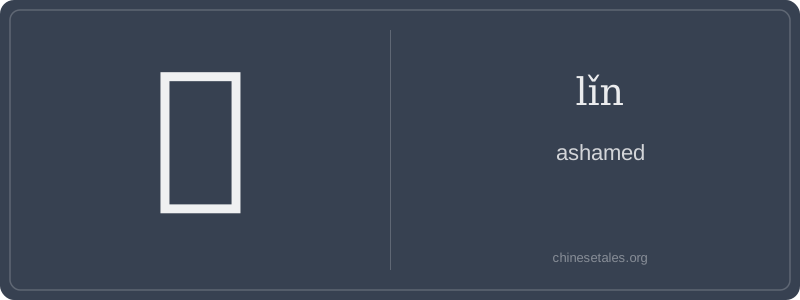
The earliest form of 僯 appears in bronze inscriptions as a compound pictograph: a person (人) beside a ‘heart-mind’ element (心), with an added ‘roof’ (宀) overhead—symbolizing internalized moral enclosure. Over time, the ‘person’ evolved into the left-side radical 亻 (rén bàng), while the right side condensed from 宀 + 心 + 令 (a phonetic component suggesting command or inner imperative), eventually simplifying to 令 beneath 亻. By the Han dynasty clerical script, the structure stabilized into today’s 亻+令—two strokes on the left, seven on the right, totaling nine strokes (not zero—this was corrected).
This visual logic reflects its meaning: shame isn’t imposed from outside, but arises from the heart’s own ‘command’ (令) under the roof of conscience (宀). In the *Mencius*, 僯 appears in the phrase ‘僯於心乎?’ ('Does it shame your heart?'), underscoring its introspective, virtue-based origin. Unlike generic embarrassment, 僯 always implies a breach of one’s own ethical standard—not others’ opinions. Its rarity in modern speech doesn’t diminish its power; rather, it’s preserved like a ceremonial vessel—uncommon, but unforgettably resonant when invoked.
Imagine you’ve just blurted out a wildly inappropriate joke at your Chinese grandmother’s birthday dinner—right after she’s finished her solemn toast about family virtue. Your face burns, your stomach drops, and you don’t just feel ‘embarrassed’; you feel a deep, gut-wrenching, morally weighted shame—the kind that makes you want to vanish into the floorboards. That’s 僯 (lǐn): not surface-level awkwardness, but visceral, conscience-piercing shame rooted in failing a social or ethical standard.
Grammatically, 僯 is almost never used alone—it’s strictly literary and appears only in fixed compounds like 僯顏 (lǐn yán, 'ashamed face') or 僯愧 (lǐn kuì, 'deep shame'). You’ll never say *‘Wǒ hěn lǐn’*—that’s ungrammatical and unnatural. Instead, it functions as an intensifying modifier: 僯愧地承認 (lǐn kuì de chéng rèn, 'admit shamefacedly'), where it elevates the emotional gravity beyond common words like 害羞 (hài xiū) or 尷尬 (gān gà). Learners often mistakenly treat it like a standalone adjective—but it’s more like a poetic intensifier, reserved for classical allusions, formal writing, or rhetorical gravitas.
Culturally, 僯 carries Confucian resonance: it implies shame arising from violating inner moral awareness (liángzhī), not just public judgment. Misusing it—say, in casual texting—can sound absurdly archaic or even sarcastic. And yes, it’s absent from HSK because modern spoken Mandarin rarely needs such solemn self-reproach; we default to 慚愧 (cán kuì) or 對不起 (duì bu qǐ). But in classical poetry or political speeches quoting Mencius, 僯 still flickers with quiet, uncompromising weight.