僭
Character Story & Explanation
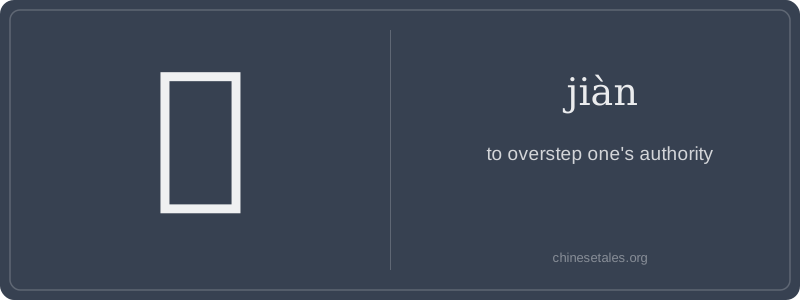
The earliest form of 僭 appears in Warring States bamboo slips—not as a pictograph, but as a carefully constructed ideograph. Its left side, 亻 (rén), marks ‘person’; its right side combines 憸 (xiān, ‘sly, deceitful’) and 龺 (an archaic variant of ‘涉’, shè, ‘to wade across’). Visually, it’s a person wading *across* boundaries *with sly intent*. Over centuries, the right side simplified into 潜 (qián, ‘to hide/submerge’) + 曰 (yuē, ‘to speak’), then further condensed to today’s 朁 (cǎn) — a phonetic component echoing jiàn, while preserving the sense of stealthy crossing. The 14 strokes encode layered meaning: the two dots (丶丶) atop 朁 suggest ‘eyes watching from above’—Heaven observing the transgression.
This character first crystallized in the *Zuo Zhuan* (c. 4th c. BCE), where it condemned feudal lords who ‘wore the Son of Heaven’s ceremonial cap’—not to seize power, but to *mimic* it ritually. Confucius himself warned that ‘when names are not correct, language is not in accordance with the truth of things’—and 僭 was the ultimate ‘incorrect name’. Its visual form mirrors its moral gravity: the 亻 radical stands upright, yet the complex right side leans leftward, visually *off-balance*, as if the very character recoils from its own meaning.
Imagine a Ming dynasty palace guard—dressed in plain grey robes, standing respectfully at the edge of the imperial audience hall. Suddenly, he steps forward *past* the red lacquered barrier, bows *as if* he were a prince, and begins reciting state policy. That’s not ambition—it’s 僭 (jiàn): an act so culturally radioactive that it isn’t just rude, it’s cosmologically dangerous. In classical Chinese, 僭 doesn’t mean ‘to be bold’ or ‘to try hard’—it means *to usurp ritual status*, to wear the wrong hat, speak with the wrong intonation, or occupy the wrong seat in a hierarchy ordained by Heaven itself.
Grammatically, 僭 is almost always used as a verb, but rarely alone: it appears in formal, literary contexts—often paired with nouns like ‘礼’ (ritual), ‘越’ (overstep), or ‘窃’ (steal). You’ll hear it in phrases like ‘僭越’ (jiàn yuè) or ‘僭称’ (jiàn chēng), never in casual speech. Learners mistakenly use it like ‘violate’ or ‘break’, but 僭 carries zero legal weight—it’s about *symbolic trespass*, not rule-breaking. Saying ‘他僭越了公司规定’ is jarringly wrong; it belongs in texts about emperors, ancestral rites, or Confucian decorum—not office handbooks.
Culturally, this character pulses with the quiet fury of Confucian orthodoxy: every stroke enforces the idea that harmony depends on knowing your place—not as oppression, but as cosmic grammar. Modern usage is rare, mostly confined to historical novels, scholarly critiques, or biting political satire. Mistake it for ‘践’ (jiàn, ‘to trample’) or ‘僭’ for ‘渐’ (jiàn, ‘gradually’), and you’ll accidentally accuse someone of ‘gradually stealing the emperor’s robes’—a wonderfully absurd error no native speaker would make.