僩
Character Story & Explanation
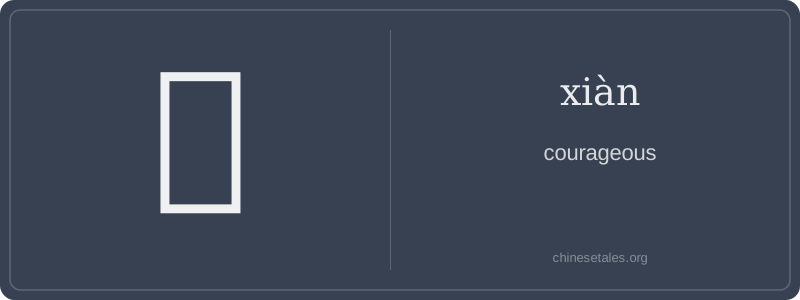
The earliest form of 僩 appears in bronze inscriptions of the late Zhou dynasty: a figure (人 radical) standing upright beside a simplified depiction of a ritual vessel (represented by the upper component, now evolved into the 亠 + 口 + 彐 structure), symbolizing a person embodying ceremonial dignity and moral authority. Over centuries, the vessel motif stylized into the top portion (亠 + 口 + 彐), while the 亻 (person) radical anchored its human meaning — every stroke reinforcing the idea of a person grounded in ritual propriety and inner fortitude.
This character first appeared in the Book of Rites (Lǐjì), where ‘僩然’ describes the composed, awe-inspiring presence of a gentleman whose virtue is so profound, his mere bearing commands respect. Mencius later echoed it, linking 僩 to ‘unbending righteousness’. Visually, the balanced symmetry — left-side 亻, right-side complex upper structure — mirrors its semantic core: moral courage isn’t impulsive; it’s centered, measured, and ritually grounded.
Imagine a Tang dynasty scholar standing before the emperor, robes rustling, not with swagger but with quiet, unshakable resolve — head high, shoulders steady, voice clear as temple bells. That’s 僩 (xiàn): not loud bravery, but dignified courage rooted in moral conviction and inner strength. It’s the courage of principle, not adrenaline — the kind you see in Confucian texts praising gentlemen who uphold righteousness even when alone.
Grammatically, 僩 is almost never used alone in modern speech; it appears almost exclusively in classical compounds like 僩然 (xiànrán) or 僩俔 (xiànqiè), usually as an adjective modifying nouns or describing demeanor. You won’t hear ‘他很僩’ — that sounds archaic and unnatural. Instead, it’s literary: ‘僩然之色’ (the solemn, courageous bearing of a sage). Learners often misread it as xiǎn (like 险) or force it into colloquial contexts — a classic trap, since this character breathes only in classical air.
Culturally, 僩 carries the weight of ru (Confucian) self-cultivation: courage as a cultivated virtue, inseparable from integrity and composure. It’s absent from HSK because it’s functionally obsolete in daily life — yet revered in calligraphy, classical poetry, and scholarly discourse. Mistake it for a synonym of 勇 (yǒng), and you’ll miss its subtle nuance: 勇 is raw bravery; 僩 is bravery polished by virtue and stillness.