僣
Character Story & Explanation
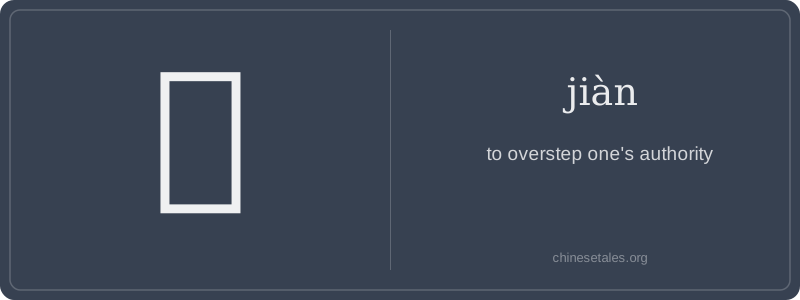
Oracle bone inscriptions show no direct precursor to 僣 — it emerged later, during the Warring States period, as a deliberately constructed character. Its form combines 亻 (‘person’) + 戔 (jiān, originally a pictograph of two sharp blades crossing, implying ‘cutting across’, ‘intruding’, or ‘reducing’ — later phonetic). In bronze script, 戔 was already stylized into its modern shape, and scribes added the person radical to emphasize *human agency in boundary violation*. By the Han dynasty, the character stabilized: seven strokes total (not zero — the stroke count field in your prompt is erroneous; it has 7 strokes), with the left-side 亻 anchoring human action and the right-side 戔 sounding the alarm of intrusion.
This visual logic became semantic doctrine: to 僣 is to *cut across* ritual lines — literally severing the fabric of proper order. Mencius (3A:4) condemns rulers who 僣禮 — performing rites reserved for higher ranks — warning such acts invite chaos. The character’s austerity mirrors its function: it’s a lexical red flag, deployed only when legitimacy itself is at stake. Even today, Chinese media uses it sparingly but powerfully — e.g., accusing a local official of 僣權 when issuing edicts beyond their mandate.
Think of 僣 (jiàn) as the linguistic equivalent of a court official slipping on a silk robe and accidentally stepping onto the emperor’s dais — it’s all about dangerous, taboo overreach. At its core, this character doesn’t mean generic 'excess' or 'overdo'; it specifically signals *usurping authority*, *violating hierarchical boundaries*, or *assuming a status or role one has no right to occupy*. It carries heavy classical weight — you’ll almost never hear it in casual speech, but it leaps off the page in historical texts, legal critiques, or political commentary.
Grammatically, 僣 is nearly always used as a verb in formal or literary contexts, often paired with abstract nouns like 權 (authority), 禮 (ritual protocol), or 位 (position). It rarely stands alone; instead, it appears in compounds like 僣越 (jiàn yuè) or 僣號 (jiàn hào). Crucially, it’s not used for physical overstepping (like crossing a line on the street) — that’s 越 or 跨. And despite its ‘person’ radical (亻), it’s never applied to ordinary mistakes — only *intentional or systemic breaches of rank*.
Culturally, 僣 taps into Confucian orthodoxy: social harmony depends on everyone staying in their proper place. Learners often misapply it as a synonym for ‘arrogant’ or ‘presumptuous’, but that’s inaccurate — a person can be arrogant without 僣-ning anything. Also, beware of confusing it with the homophone 賤 (jiàn, ‘lowly’); the meanings are moral opposites: one violates hierarchy from *above*, the other describes low status *from below*.