佥
Character Story & Explanation
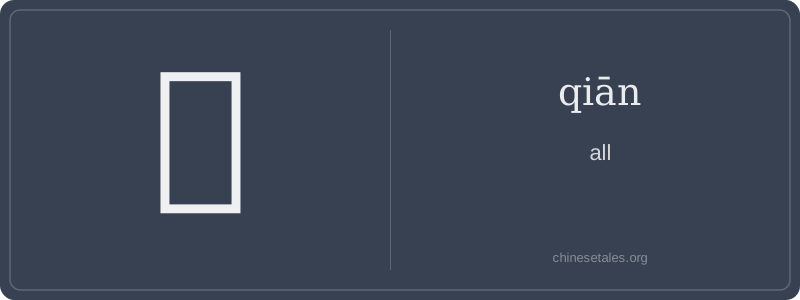
The earliest form of 佥 appears on Western Zhou bronze inscriptions as a stylized cluster of three human figures facing inward — not standing side-by-side, but leaning toward a shared center, like elders gathered around a divination board. Over centuries, the top simplified into 亼 (a variant of 今, suggesting 'present moment'), while the two lower 人 forms remained distinct but compressed vertically. By the seal script era, the three-person motif had fused into the modern 佥: 亼 crowning two mirrored 人 radicals — visually echoing consensus forming from convergence.
This visual logic shaped its meaning: in the Book of Documents (Shàngshū), 佥 appears in phrases like 佥曰 (qiān yuē) — 'all said in unison' — describing ministers speaking as one voice before the king. Unlike generic 'all' characters, 佥 always implies volition and alignment. Even today, in legal or ceremonial language, 佥 retains this aura of solemn, collective affirmation — not passive totality, but active concord. Its shape isn’t just 'people'; it’s 'people leaning in, agreeing'.
Think of 佥 (qiān) as the ancient Chinese word for 'all together' — not just quantity, but collective agreement and shared action. It carries a weighty, formal resonance, like raising hands in unison at a council meeting. You’ll rarely hear it in casual speech; it lives in classical texts, official documents, and compound words. Its core feeling is unity with intention — not just 'everyone', but 'everyone *in accord*'. That’s why it’s often paired with verbs like 'agree', 'decide', or 'certify'.
Grammatically, 佥 almost never stands alone as a pronoun like 'all' in English. Instead, it functions as an adverb meaning 'unanimously' or 'collectively', or appears only within multi-character compounds (e.g., 佥曰 'all said'). Learners sometimes try to substitute it for 全 (quán) or 都 (dōu), but that’s like using 'yea' instead of 'yes' in modern English — technically correct, historically loaded, and socially jarring outside ritual or literary contexts.
Culturally, 佥 evokes the Confucian ideal of harmonious consensus: decisions made not by decree, but by unified voice. A common mistake is misreading its radical — though it contains 人 (person), it’s not about individuals per se, but their convergence. And yes, its seven strokes include three stacked 'people' (亼 + 人 + 人), but don’t memorize it as 'three people'; think of it as 'voices rising as one'. Its rarity in spoken Mandarin makes it a delightful 'Easter egg' for learners who spot it in historical dramas or temple inscriptions.