僇
Character Story & Explanation
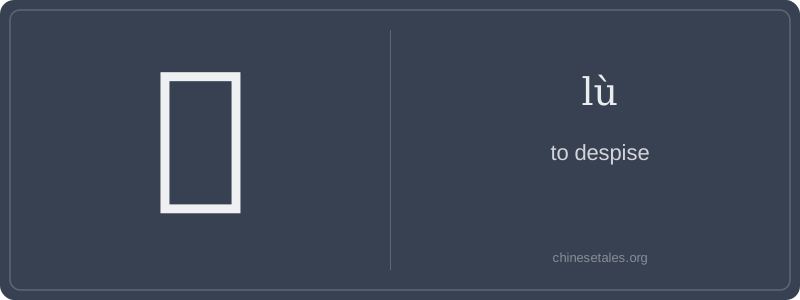
The earliest form of 僇 appears in bronze inscriptions as a human figure (亻) beside a phonetic component resembling 'lü' — likely derived from lù (a type of ceremonial vessel or perhaps 'to expose'). Over time, the right side standardized into 留 (liú), which originally depicted a person under a roof holding a weapon — implying 'to detain' or 'to hold back'. By the Han dynasty, the character fused into today’s shape: 亻+留, visually merging 'person' with 'detention', encoding the idea of a human being publicly held up for shame.
This visual logic directly shaped its meaning: to humiliate wasn’t abstract — it was physical exposure, social detention, and loss of standing. In the Zuo Zhuan, 僇 appears when a noble is 'stripped of insignia and paraded' — the character itself became the script for that ritual. Even its pronunciation, lù, echoes the sharp, clipped tone of a judge’s gavel. Unlike gentle synonyms like bēi (to belittle), 僇 always implied institutional authority behind the scorn — making it less a feeling than a sentence.
僇 is a rare, literary character meaning 'to despise' or 'to humiliate' — not just mild disapproval, but deep, public scorn with moral weight. Think of an ancient official publicly stripping another of rank and title: it’s visceral, punitive, and socially lethal. In Classical Chinese, it often appears in legal or historical texts (like the Records of the Grand Historian) paired with verbs like zhū (to execute) or liè (to brand), signaling ritualized disgrace. Modern Mandarin almost never uses it alone — you won’t hear it in daily speech or HSK materials.
Grammatically, 僇 functions as a transitive verb, typically followed by an object (e.g., 僇其名 — 'to disgrace his name'). It rarely takes aspect particles like le or guo, and never appears in casual compound verbs like gǎnjué or xǐhuan. Learners mistakenly try to use it like kàn bù qǐ ('to look down on'), but 僇 carries judicial gravity — it implies formal condemnation, not personal attitude. Using it in a coffee-shop chat would sound like you’re sentencing your barista to exile.
Culturally, 僇 belongs to the lexicon of imperial punishment — one of several characters (zhū, fá, xíng) that formed a grim semantic family around state-inflicted shame. Its rarity today makes it a linguistic fossil: fascinating to scholars, invisible to most native speakers. The biggest mistake? Confusing its radical (亻) with similar-looking characters like lù (路) or lǜ (律). Remember: this isn’t about roads or laws — it’s about stripping dignity, stroke by deliberate stroke.