僄
Character Story & Explanation
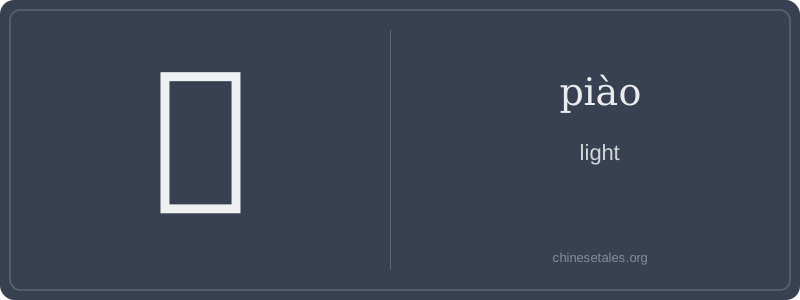
The earliest form of 僄 appears in seal script (not oracle bone, which lacks it), where its left side was the 'person' radical (亻) — signaling human action — and the right side was 票 (piào), originally a pictograph of a flying banner or fluttering token, suggesting motion, speed, and something airborne. Over centuries, the right component simplified from 票’s full form (with 'feather' and 'knife' elements) into today’s streamlined shape, while the left retained its human essence — together whispering 'a person moving with airy ease.'
By the Han dynasty, 僄 appeared in texts like the *Shuōwén Jiězì* as meaning 'nimble, swift, and spirited', applied to both martial prowess and rhetorical brilliance. In the *Wen Xuan* anthology, poets used 僄轻 to praise writing that soared without heaviness — a metaphor still resonant in Chinese aesthetics. Its visual rhythm — compact yet dynamic — mirrors its semantic core: economy of form yielding maximum expressive lift.
Forget 'light' as in photons — 僄 (piào) is lightness with attitude: nimble, sprightly, almost recklessly buoyant. It’s not about weightlessness, but about kinetic grace — the dancer’s leap, the acrobat’s flip, the scholar’s witty, effortless turn of phrase. In classical Chinese, it described physical agility and mental quickness alike, carrying a faintly poetic or even slightly archaic charm. You won’t hear it in daily chat; it lives in literary descriptions, historical texts, and set phrases where elegance and vivacity are key.
Grammatically, 僄 functions almost exclusively as an adjective, often paired with other characters in fixed compounds like 僄捷 (piào jié) or 僄轻 (piào qīng). It rarely stands alone and never acts as a verb or noun. Learners sometimes misread it as piāo (like 飘) due to visual similarity — a dangerous slip, since piāo means 'to float' and carries no connotation of skill or spirit. Also, don’t try to use it like 简单 (jiǎndān, 'simple') — it’s not neutral; it implies admirable, energetic lightness, not mere lack of complexity.
Culturally, 僄 evokes the Daoist ideal of effortless action (wúwéi), but with flair — think of a sword master whose movements seem weightless yet decisive. Modern usage is rare and highly stylized; seeing it outside classical allusions or formal literary criticism is like spotting a phoenix in a subway station. Its rarity makes it a subtle marker of advanced reading ability — and a trap for those who overgeneralize from similar-looking characters.