伛
Character Story & Explanation
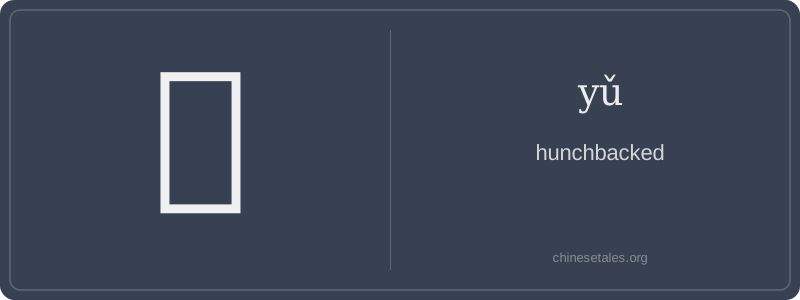
The earliest form of 伛 appears in seal script as a person radical (亻) beside a component resembling a bent spine — originally written as 弓 (gōng, 'bow'), which visually mimicked a curved back. Over time, 弓 simplified into the modern 又 (yòu, 'again') shape — not because of meaning, but due to clerical script streamlining: scribes traced the curve so quickly it looked like 又. So today’s 伛 is literally 'person + curved shape' — a brilliant stroke of visual economy. Its six strokes map perfectly: two for the person radical (丿 + 丨), then four for the bent-back glyph ( + 一 + 丶 + 丶), where those two dots suggest shoulders sagging under invisible weight.
This bending wasn’t just physical — classical texts used 伛 to signal moral or emotional yielding. In the Zuo Zhuan, ministers are described as 伛身以示敬 (bending the body to show reverence), making posture a performative virtue. Later, in Tang poetry, 伛 became associated with scholarly exhaustion — Li He wrote of '伛偻拾穗者' (the bent-backed grain-gatherers), transforming labor into lyrical gravity. The character’s minimalism — just six strokes — belies its layered resonance: it’s not deformity, but the human body negotiating time, duty, and earth.
At its core, 伛 isn’t just a clinical descriptor like 'hunchbacked' — it’s a quietly empathetic, almost literary word that carries the physical weight of age, labor, or sorrow. You won’t hear it in casual speech ('He’s hunched' is usually 他驼着背 or 他弯着腰); instead, 伛 appears in writing and formal narration to evoke dignity amid frailty — think of an elderly scholar bending over ancient texts or a farmer bowed by decades in the fields. It’s inherently visual and respectful, never mocking.
Grammatically, 伛 functions almost exclusively as a verb (to bend forward at the waist) or as part of compound adjectives like 伛偻 (yǔ lóu). It rarely stands alone: you’ll see it in structures like 伛着身子 (yǔ zhe shēn zi, 'bending one’s body') or as a stative verb in descriptive clauses: '老人伛着背在巷口晒太阳' (The old man sits sunning himself at the alley entrance, back bent). Note: it’s not used attributively before nouns without a modifier — you wouldn’t say *伛老人; it’s always 伛偻的老人 or 伛着背的老人.
Culturally, 伛 reflects a deep Chinese sensitivity to posture as moral and physiological language: upright = upright character (正直), bent = endurance, humility, or decline. Learners often mispronounce it as yū or yú — but the third tone (yǔ) is essential, matching words like 雨 (rain) and 语 (language), subtly linking bodily curvature to the falling motion of rain or the downward inflection of quiet speech. Also, don’t confuse it with characters meaning 'stoop' from laziness — 伛 implies earned, dignified bending, not slouching.