偬
Character Story & Explanation
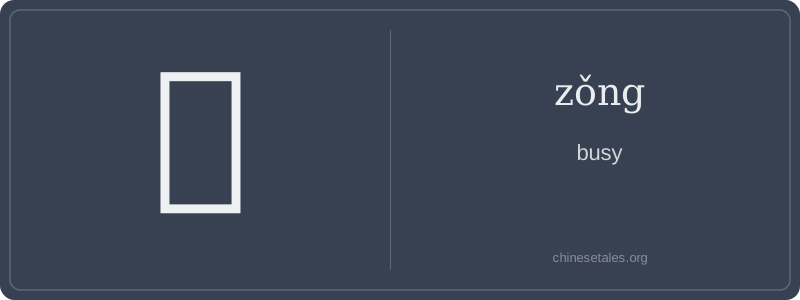
The earliest form of 偬 appears in Han dynasty clerical script, evolving from a combination of 亻 (person) and 從 (cóng, 'to follow'), but crucially — not the modern 從. The original bronze script ancestor depicted two people walking closely together, one literally 'following' the other in rapid succession — a visual metaphor for relentless motion, no pause, no breathing room. Over centuries, the right side simplified: the doubled '人' in 從 became the condensed '忩' (a now-obsolete variant), then further stylized into the current shape with the dot and horizontal stroke above '从'. By the Kangxi dictionary era, the radical had settled firmly as 亻 + 忩 — eleven strokes total, each contributing to the sense of compact, urgent human activity.
This pictorial origin explains why 偬 never means mere 'busyness' but specifically 'busyness with forward momentum and sequence' — think of couriers dashing between palaces, scribes copying edicts without rest, or generals issuing orders mid-march. It appears in the Classic of Filial Piety commentary describing Confucius’ disciples moving '偬偬然' — not just quickly, but in disciplined, successive motion. The character’s visual rhythm — the upright 亻 followed by the cascading strokes of 忩 — mirrors its meaning: a person leaning into motion, time compressing around them.
Think of 偬 (zǒng) as the Chinese equivalent of that frantic, slightly theatrical 'busy bee' energy — not just 'occupied', but visibly flustered, sleeves rolled, papers fluttering. Unlike common synonyms like máng (忙) or fán (烦), 偬 carries a literary, almost classical weight: it suggests busyness with purpose, urgency, and often a touch of dignified exhaustion — like a Ming-dynasty magistrate reviewing petitions at midnight, not a modern office worker checking Slack.
Grammatically, 偬 is almost exclusively an adjective — never a verb — and appears mainly in formal or literary contexts: it modifies nouns directly ('偬偬的身影'), or forms reduplicative adverbs like 偬偬 (zǒng zǒng) meaning 'hurriedly, in haste'. You won’t hear it in casual speech ('I’m busy') — saying *wǒ hěn zǒng* would sound bizarrely archaic, like saying 'I am e'en beset' in English. Instead, it thrives in set phrases: 偬偬 (hurried), 匆偬 (cōng zǒng, 'hurried and flustered'), and especially in the compound 匆匆偬偬, which evokes vivid, almost cinematic urgency.
Culturally, 偬 is a 'ghost character' — rare in daily use but deeply embedded in idioms and classical allusions. Learners often misread it as zòng (like 縱) due to its right-hand component, or confuse it with 悚 (sǒng, 'to shudder') because of the 忄-lookalike radical. But 偬 has no emotional fear — only temporal pressure. Its rarity makes it a subtle marker of linguistic sophistication: spotting it in a Tang poem or a modern essay signals the writer’s command of layered, rhythmic diction.