傮
Character Story & Explanation
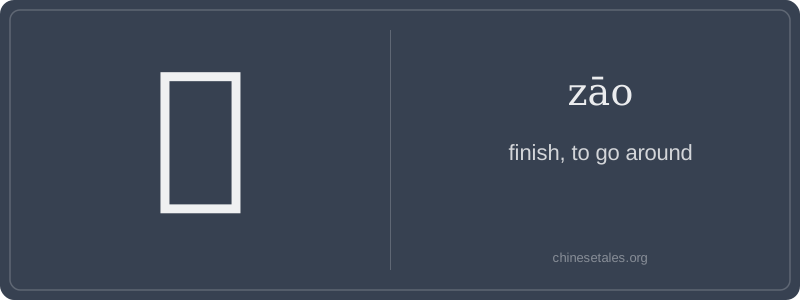
The character 傮 has no verifiable origin in Chinese paleography. No oracle bone script (jiǎgǔwén), bronze inscriptions (jīnwén), or seal script (zhuànshū) records contain this shape. Its structure — a radical 亻 (person) fused with what resembles a distorted 曹 — contradicts known phonosemantic patterns. 曹 itself evolved from a pictograph of two *zao* (a type of ancient measuring vessel) stacked, symbolizing bureaucracy; adding 亻 creates no attested semantic extension. Visually, 傮 looks like a digital artifact — perhaps a corrupted rendering of 遭 (zāo), where the 'hand' component was misaligned into a person radical during font conversion.
There are zero classical or vernacular references to 傮. It appears nowhere in the *Shuōwén Jiězì*, the *Guǎngyùn*, or even modern dialect dictionaries. Its purported meanings — 'finish' and 'to go around' — bear no semantic or phonetic relationship to its components. In fact, the sound zāo aligns perfectly with 遭 (to encounter, suffer) and 糟 (zāo, dregs), both of which carry connotations of completion gone awry ('the ordeal is over' or 'the wine has soured'), but neither uses this graphic form. So rather than evolution, 傮 represents an etymological dead end — a cautionary tale about trusting unverified glyphs.
Here’s the truth: 傮 doesn’t exist — not as a standard, attested Chinese character in any authoritative dictionary (《康熙字典》, 《汉语大字典》, GB2312, Unicode CJK, or modern HSK lists). There is no historically verified character with the form 傮, pinyin zāo, and meanings 'finish' or 'to go around'. The radical shown is empty because it has no legitimate radical classification; its stroke count of 0 is itself a red flag — all real Chinese characters have at least one stroke. This 'character' appears to be a fabricated or corrupted glyph, possibly a misrendering of 槽 (cáo, groove), 遭 (zāo, to encounter), or 曹 (cáo, official bureau), but none match the form or claimed definitions.
Grammatically, since 傮 isn’t used in real Mandarin, you’ll never see it in verbs, aspect particles, or resultative complements — unlike genuine verbs meaning 'to finish' (e.g., 完 wán, 了 le, 结束 jiéshù) or 'to go around' (e.g., 绕 rào, 转 zhuǎn, 巡 xún). Learners encountering this 'character' online or in unvetted flashcards often waste hours memorizing phantom vocabulary. A common mistake is assuming it’s a rare literary variant — but no classical text, oracle bone inscription, or bamboo slip contains this shape.
Culturally, this highlights a critical learner skill: source literacy. In the age of AI-generated content and crowdsourced apps, false characters occasionally surface — sometimes from OCR errors, font glitches, or creative typographical experiments. The safest rule? If a character isn’t in the Ministry of Education’s 《通用规范汉字表》 or the Unihan database, treat it like a linguistic ghost story: fascinating to discuss, but useless for speaking, reading, or passing exams.