傣
Character Story & Explanation
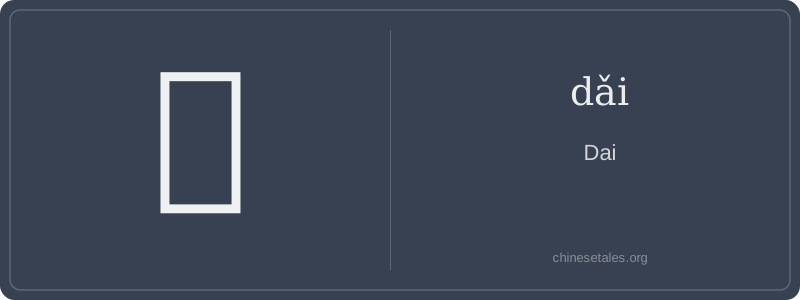
The earliest traceable form of 傣 appears not in oracle bones but in late Qing dynasty ethnographic documents and Republican-era transliteration systems. Its modern shape merges two elements: the left-side 亻 (rén bàng, 'person' radical) — standard for ethnic group names — and the right-side 太 (tài), borrowed phonetically to approximate the native autonym /taj/ or /tai/ (as in Tai peoples). Visually, the 12 strokes evolved from handwritten clerical script forms where 太 was simplified from its full form (大 + 丶) and fused tightly with 亻 — note how the final stroke of 亻 (a downward slant) connects fluidly into the top horizontal of 太, creating visual cohesion without ambiguity.
This character wasn’t invented anciently; it was standardized in the 1950s during China’s ethnic identification project, when linguists and anthropologists selected 太 for its close sound match and neutral connotation (unlike alternatives like 泰, which means 'peaceful' but carries geopolitical baggage). Though absent from classical texts, 傣 now appears in official documents, school textbooks, and bilingual signage across Xishuangbanna — where its presence affirms recognition, not description. The character’s quiet symmetry — balanced radicals, even stroke distribution — subtly mirrors the Dai ideal of harmony with nature, visible in their bamboo architecture and water-splashing festivals.
Think of 傣 (dǎi) like the Chinese equivalent of 'Celtic' in English — not a generic word for 'people', but a precise, culturally loaded proper noun that names one of China’s 56 officially recognized ethnic groups: the Dai people, centered in Yunnan and sharing linguistic and cultural ties with Thai and Lao communities. Unlike common nouns such as 人 (rén, 'person') or 民族 (mínzú, 'ethnic group'), 傣 appears almost exclusively as a modifier — always capitalized in effect, never used alone to mean 'a person' or 'Dai-ness'. You’ll see it only in compound terms like 傣族 (Dǎi zú, 'Dai nationality') or 傣语 (Dǎi yǔ, 'Dai language').
Grammatically, 傣 functions strictly as an attributive noun — it behaves like an uninflected proper adjective. You’d never say *‘他是傣’ (*Tā shì Dǎi) — that’s as unnatural as saying *‘He is Celtic’ in English. Instead, you say 他是傣族人 (Tā shì Dǎi zú rén, 'He is a Dai person'), where 傣 must be bundled with 族 or another classifier. Learners often mistakenly treat it like a standalone noun or try to pluralize it — but 傣 has no plural form, no verb usage, and zero colloquial slang variants.
Culturally, mispronouncing or miswriting 傣 can unintentionally signal ignorance about ethnic diversity in China. Its tone (third tone dǎi) is frequently misread as first tone (dāi), which sounds like a different character entirely (e.g., 着急的 ‘anxious’). Also, because it contains the 亻 (person) radical, some learners wrongly assume it relates to behavior or personality — but it carries no semantic weight beyond ethnic identity. It’s purely nominal, historical, and honorific: a linguistic passport issued by the state, not a descriptive label.