傞
Character Story & Explanation
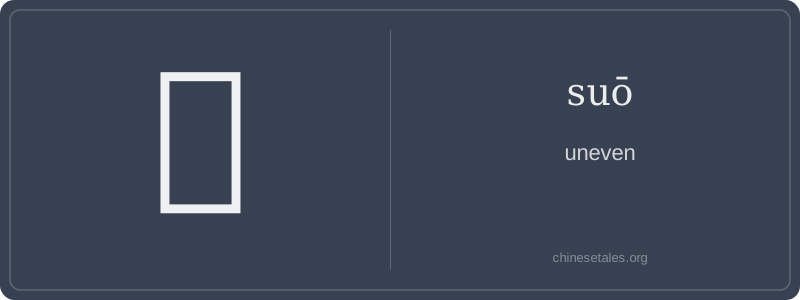
The earliest trace of 傞 appears not in oracle bones but in late Warring States bamboo slips, where it emerges as a variant of 梭 — but with a crucial twist: the left radical shifts from 木 (wood) to 亻 (person), and the right component evolves from 棱 (sharp edge) into a stylized, zigzagging ‘saw-tooth’ shape resembling irregular peaks. Visually, it’s two people (亻亻) standing askew on uneven ground — one taller, one crouched — captured in ink that deliberately avoids symmetry. Over centuries, clerical script smoothed the angles, but preserved the off-kilter tension in the diagonal strokes.
This visual imbalance directly seeded its meaning: by the Tang dynasty, 傞 appears in Li Bai’s marginalia describing ‘mountains 傞然 rising like drunken sages’ — implying wilful, charismatic disorder. Unlike 平 (píng, flat) or 齊 (qí, even), which imply harmony or control, 傞 celebrates *intentional asymmetry* — a Daoist wink at nature’s refusal to be squared. Its rarity today isn’t due to obsolescence, but preservation: it’s kept alive like a rare orchid, blooming only where poetic precision demands a word that means ‘uneven’ *and* ‘alive’ at once.
Imagine you’re walking barefoot on an old stone path in a mountain village — some stones jut up like crooked teeth, others sink into the earth, and your ankle wobbles with every step. That’s 傞 (suō): not just ‘uneven’ in a textbook sense, but *viscerally lopsided*, *asymmetrically jagged*, almost defiantly unbalanced. It’s the kind of uneven that makes you pause — not because it’s dangerous, but because it feels *alive*, stubbornly refusing to conform.
Grammatically, 傞 is almost never used alone. It appears almost exclusively in fixed literary compounds like 傞傞 (suō suō) or 傞然 (suō rán), where it intensifies the sense of irregularity — often describing natural landscapes (a craggy cliffside), aged wood grain, or even abstract things like rhythm in classical poetry. You’ll never say ‘this table is 傞’ — that would sound bizarre and archaic. Instead, you’d say 山勢傞傞 (shān shì suō suō), evoking mountains that rise in chaotic, untamable succession. Learners mistakenly treat it like a modern adjective (like 不平 bù píng), but it’s strictly poetic, ornamental, and nearly extinct in speech.
Culturally, 傞 carries quiet reverence for nature’s imperfection — think wabi-sabi before the term existed. Classical poets used it to contrast human order with wild asymmetry, subtly critiquing rigid Confucian ideals. A common mistake? Confusing it with 梭 (suō, shuttle) — same sound, completely unrelated meaning and origin. Also, don’t try to write it with fewer strokes: its 12-stroke form is non-negotiable; skipping strokes turns it into nonsense or another character entirely.