傜
Character Story & Explanation
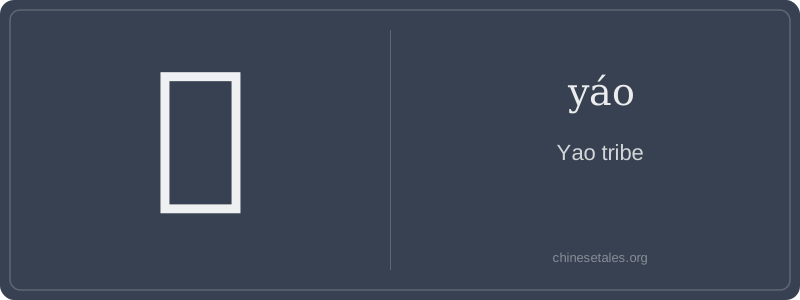
The character 傜 first emerged in late imperial manuscripts — likely during the 16th–17th centuries — as a variant of 瑶. Its form combines the 亻 (rén, ‘person’) radical on the left, signaling human reference, with the phonetic component 爻 (yáo), borrowed for its sound. 爻 itself is an ancient pictograph resembling intersecting divination rods — originally representing cosmic change in the Yìjīng — and was repurposed here purely for pronunciation. No oracle bone or bronze script version exists; this is a bureaucratic invention, not an evolutionary survivor. Visually, it’s a streamlined fusion: two strokes for the person radical, then six precise strokes forming 爻 — crossing lines that evoke both ritual order and administrative precision.
Historically, 傜 appears in Ming-era gazetteers like the 《Guǎngxī Tōngzhì》 (Comprehensive Gazetteer of Guangxi), where it labels communities exempt from certain taxes due to their remote highland settlements. By the Qing dynasty, it gained official status in tributary records — always paired with classifiers like 族 (zú, ‘ethnic group’) or 人 (rén, ‘people’). Interestingly, the character’s visual austerity — no decorative elements, no semantic hints about terrain or culture — mirrors its function: a neutral, functional label in a vast imperial filing system. Its endurance lies not in poetic resonance but in archival weight — a silent witness to how language codifies identity.
At first glance, 傜 looks like a bureaucratic label — and that’s exactly what it is: a historical ethnonym created during the Ming and Qing dynasties to classify the Yao people, an Indigenous ethnic group native to southern China’s mountainous regions (Guangxi, Hunan, Yunnan, Guangdong). The character isn’t ancient; it doesn’t appear in oracle bones or the Shuōwén Jiězì. Instead, it’s a late imperial ‘constructed character’ — deliberately coined using existing components to signal both ethnicity and administrative categorization. Its meaning is strictly sociopolitical, not descriptive: it carries no inherent qualities like 'brave' or 'mountain-dwelling'; it simply names a group as recognized (and often regulated) by imperial census and taxation systems.
Grammatically, 傜 functions almost exclusively as a noun, always in proper nouns or ethnographic contexts — never as a verb, adjective, or standalone pronoun. You’ll only see it in compound terms like 瑶族 (Yáo zú, ‘Yao ethnic group’) or place names like 瑶山 (Yáo Shān, ‘Yao Mountains’). Crucially, it’s *never* used alone in speech or writing — unlike common nouns such as 人 (rén, ‘person’), you’d never say ‘傜很友好’; instead, you’d say ‘瑶族人民很友好’. Learners sometimes mistakenly treat it as a generic adjective or omit the required classifier, leading to unnatural or historically tone-deaf phrasing.
Culturally, this character embodies a sensitive layer of China’s ethnic taxonomy: it reflects how Han-dominated state apparatuses historically named and administrated minority groups — sometimes with respect, often with distance or paternalism. Modern usage favors 瑶 (yáo), the standard simplified form, while 傜 survives mainly in historical documents, pre-1950s texts, or specialized academic transliterations. A common mistake? Confusing it with 瑶 (same pronunciation, same meaning, but different radical and stroke structure) — which isn’t just a typo; it signals whether you’re quoting a Ming edict or citing a 2023 government white paper.