伧
Character Story & Explanation
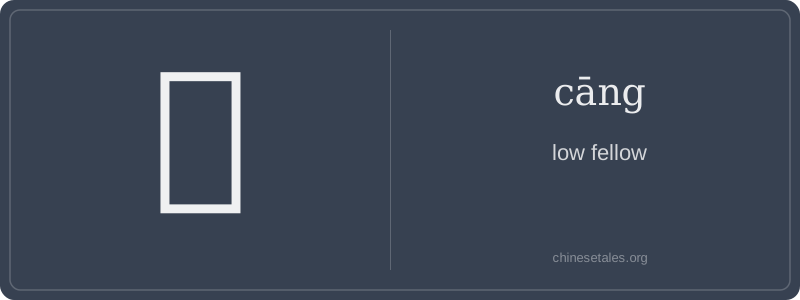
The earliest form of 伧 isn’t pictographic — it’s phono-semantic. Its left side 亻 (rén bàng) signals ‘person’, while the right side 仓 (cāng) was borrowed for its sound, not its meaning. In oracle bone and bronze scripts, there was no standalone 伧 — it emerged late, during the Wei-Jin period (3rd–4th c. CE), when scholars needed a written marker for the scorned ‘northern rustic’. Visually, it’s clean: two strokes for the human radical (亻), then four for 仓 — a square (囗) with two internal strokes (一 and ), mimicking grain storage — but here repurposed purely as a phonetic anchor.
The meaning crystallized in the Shì Shuō Xīn Yǔ (A New Account of the Tales of the World), where southerners mocked northerners as ‘伧’ — implying crude speech, clumsy manners, and ignorance of refined arts. The character’s simplicity (just six strokes) ironically underscores its loaded weight: minimal form, maximal disdain. Even today, the visual echo of 仓 (a humble storehouse) subtly reinforces the idea of someone ‘storing’ no culture — all surface, no depth.
At its core, 伧 (cāng) isn’t just ‘low fellow’ — it’s a linguistic sneer, a two-syllable insult compressed into one sharp, six-stroke jab. It carries the sting of cultural condescension: not merely unrefined, but *provincially* uncouth — the kind of person who misquotes poetry at a banquet or wears socks with sandals to a tea ceremony. Historically tied to northern ‘barbarian’ stereotypes during the Southern Dynasties, it’s never neutral; it always implies a contrast with cultivated, literati refinement.
Grammatically, 伧 almost never stands alone. You’ll nearly always see it in compounds like 伧俗 (cāng sú, ‘vulgar and coarse’) or 伧父 (cāng fù, ‘boorish man’). It rarely appears as a standalone noun in modern speech — using just ‘他是个伧’ would sound archaic or deliberately literary, like quoting Tang poetry mid-conversation. Learners often misread it as ‘cāng’ (like 苍), but its tone is first, not second — and confusing it with 仓 (cāng, ‘warehouse’) leads to hilarious unintended metaphors (‘He’s a warehouse!’).
Culturally, 伧 is a fossil of elite southern Chinese identity politics: when aristocrats fled north China’s invasions and settled in Jiangnan, they used 伧 to mock northern refugees — turning geography into grammar. Today, it survives mostly in literary criticism or ironic self-deprecation (e.g., ‘我这伧人,哪懂昆曲?’). Don’t use it casually — it’s sharper than a calligraphy brush dipped in vinegar.