傎
Character Story & Explanation
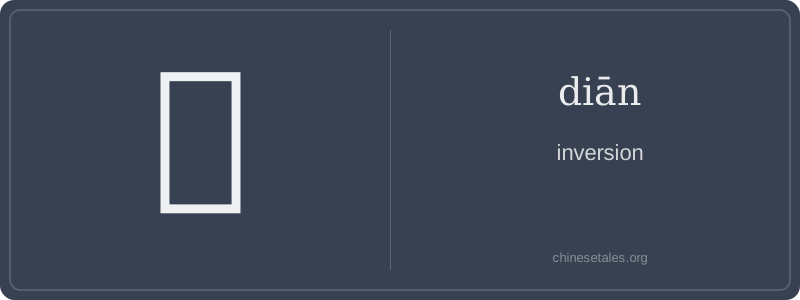
The earliest form of 傎 appears in Warring States bamboo slips — not as a pictograph, but as a phonosemantic compound. Its left side, 亻 (rén bàng, 'person'), signals human agency; the right, 殿 (diàn, 'palace hall'), originally depicted a grand roofed structure with pillars — symbolizing order, hierarchy, and sacred space. Over centuries, 殿 was simplified and stylized into the modern 又 + 殿-like shape (though now written as ⺮ + 殿’s remnants), preserving the idea of 'a place where proper sequence must hold'. The character’s very construction implies: *when a person disrupts the palace of order, inversion occurs*.
This meaning crystallized in Han dynasty texts like the *Huainanzi*, where 傎 described cosmic reversals — stars moving backward, seasons failing — signs of heavenly displeasure. By the Tang, poets used it metaphorically: Du Fu lamented 'the world 傎覆' during rebellion, evoking moral collapse, not mere chaos. Crucially, the character’s visual rhythm — upright radical on left, heavy, top-heavy right side — subtly *looks* unbalanced, mirroring its meaning. Even its stroke order ends with a downward hook that feels like a sudden, destabilizing drop — a brilliant stroke-level pun.
Think of 傎 (diān) as the Chinese word for 'upside-down logic' — not just physical flipping, but a deep, unsettling reversal of order: truth turned false, cause and effect swapped, moral compass spinning wildly. It’s not casual like 翻 (fān, 'to flip'); it carries gravity, almost alarm — like spotting your tea cup floating above the table *and realizing reality itself has glitched*. You’ll rarely hear it in daily chat; it lives in essays, satire, or solemn warnings about societal decay.
Grammatically, 傎 is almost always bound — it doesn’t stand alone. It appears in compound nouns (e.g., 傎倒, 傎覆) or as the core morpheme in literary verbs like 傎覆 (diānfù, 'to overthrow'). You won’t say *'I 傎 the book'* — instead, you’d say *'The regime was 傎覆d'*. Note: it’s never used adjectivally ('this is 傎') — that’s a classic learner trap. Use 颠 (diān), its simplified, common homophone, for 'shaken', 'tossed', or 'madness' (e.g., 颠三倒四).
Culturally, 傎 echoes ancient Daoist and Confucian anxieties about cosmic imbalance — when heaven and earth lose their proper alignment, chaos follows. Modern writers deploy it with irony or dread: describing fake news eroding truth, or power structures rewarding cruelty. Learners often misread it as 颠 (same pinyin, same radical, but different right-hand component), missing the archaic weight. Remember: 傎 is the rare, classical twin — solemn, precise, and quietly alarming.