傀
Character Story & Explanation
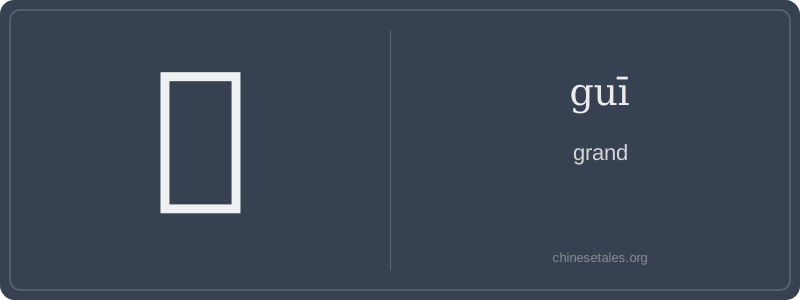
The earliest form of 傀 appears in Warring States bamboo texts and Han dynasty seals — not as a pictograph, but as a carefully constructed ideograph. Its left side 亻 (rén, 'person') anchors it in the human realm, while the right side was originally 貴 (guì, 'precious, noble'), later simplified to 圭 (guī, a jade tablet symbolizing rank and ritual authority). So visually, it’s 'a person holding or embodying the jade tablet' — a direct visual metaphor for dignified stature. Over centuries, the right component stabilized into 圭 (two horizontal lines atop a 'V'-shaped base), preserving its association with ceremonial jade and hierarchical weight.
This visual logic shaped its meaning: in the Zuo Zhuan and Han fu poetry, 傀 described rulers or monuments whose scale communicated virtue — e.g., '傀然立于朝堂' ('standing in awe-inspiring dignity in the court'). By the Tang, it became rare in isolation, surviving mainly in set phrases like 傀偉 (guīwěi, 'majestic and grand') — always reserved for natural wonders, sacred mountains, or imperial edifices. Its endurance lies not in frequency, but in precision: no other character so economically conveys *sacred bigness* — size infused with moral gravity.
At first glance, 傀 (guī) feels like a quiet giant — it’s rare in modern speech, yet carries an ancient, almost regal weight. Its core meaning isn’t just 'grand' in the flashy sense, but rather 'imposingly majestic', 'awe-inspiringly large', or 'dignified beyond ordinary scale'. Think less 'big party' and more 'a towering bronze ritual vessel in a Shang dynasty temple' — it evokes solemn grandeur, not casual size. You’ll almost never hear it in daily conversation; instead, it lives in classical allusions, literary descriptions of architecture or imperial presence, and compound words where gravity matters.
Grammatically, 傀 is almost always bound — it doesn’t stand alone as an adjective like 大 (dà). It appears only in fixed compounds (e.g., 傀然, 傀伟), usually before nouns or as part of adverbial phrases. Learners sometimes mistakenly try to say *'傀大'* or *'很傀'* — but that’s like saying 'very monarch' in English: structurally broken. It’s not gradable, not predicative, and never used in spoken comparatives. Its role is poetic, emphatic, and deeply contextual — it modifies nouns with ceremonial resonance, not everyday objects.
Culturally, 傀 subtly echoes early Chinese cosmology: size wasn’t just physical — it signaled moral authority and cosmic alignment. A 傀然 figure wasn’t merely tall, but *ritually correct*, embodying harmony between heaven, earth, and human order. Modern learners often misread it as related to 傀儡 (kuǐlěi, 'puppet') due to shared pronunciation and radical — but that’s a red herring! The meanings diverge completely: one is majestic presence, the other is manipulated absence. Confusing them accidentally turns 'the emperor’s imposing aura' into 'the emperor’s puppet' — a diplomatic disaster in classical prose!