偱
Character Story & Explanation
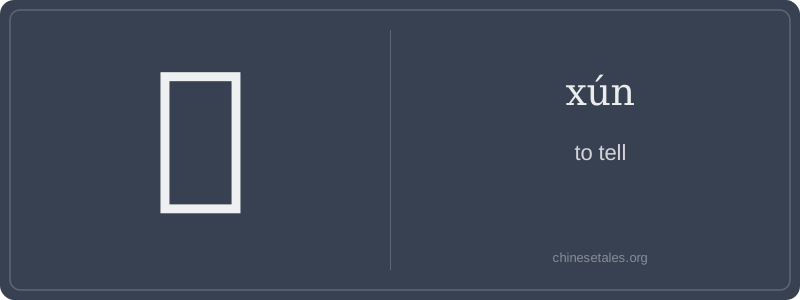
The earliest attested form of 偱 appears on Warring States bamboo slips and late Zhou bronze inscriptions as a variant of 循. Visually, it merges 亻 (person) + 隼 (jùn, 'falcon' — here serving phonetically, not semantically) — unlike 循, which uses 辶 (walking) + 隼. That ‘person’ radical was likely a scribal simplification or regional variant, perhaps emphasizing the *agent* who follows — a ruler adhering to ancestral rites, a scholar tracing moral principles. Over centuries, clerical script regularized the falcon component into the modern 隼-like shape (not to be confused with 旂 or other forms), while the 亻 remained clear. No oracle bone form survives; this is a mid-to-late Zhou innovation born of cursive convenience and phonetic borrowing.
Its meaning never strayed from 循’s core: 'to follow in sequence', 'to adhere to precedent'. In the *Zuo Zhuan*, similar constructions appear with 循 to describe ministers 'following ritual decorum'; 偱 appears only in parallel manuscript traditions where scribes substituted radicals without altering pronunciation or sense. Confucius never wrote 偱 — but if he had, it would still mean 'to walk the Way', not 'to speak it'. The visual link to 'person' + 'falcon' evokes watchfulness and precision — like a hawk circling a path before descending — reinforcing the idea of careful, deliberate adherence, not verbal transmission.
Hold on — there’s a problem: 偱 doesn’t mean 'to tell'. In fact, 偱 (xún) is not a standard modern Chinese character with that meaning at all. It’s an extremely rare, archaic variant of 循 (xún), meaning 'to follow', 'to abide by', or 'to proceed along' — never 'to tell'. This is a classic case of mistaken identity: the character 偱 appears in pre-Qin bronze inscriptions and some Song dynasty lexicographical texts as a graphic variant of 循, differing only by replacing the 'walking' radical (辶) with the 'person' radical (亻). So while it *looks* like it might involve speech (especially to learners mixing it up with 言-related characters), its core semantic field is movement, order, and conformity — think following a path, obeying ritual, or tracing a principle step-by-step.
Grammatically, when used (which is almost never in contemporary speech or writing), 偱 functions identically to 循: as a transitive verb taking abstract objects ('follow rules', 'abide by precedent', 'proceed according to law'). You’ll never see it in textbooks, apps, or HSK materials — and for good reason. Even native speakers would pause, squint, and likely read it as 循. Its use is confined to paleographic studies, critical editions of ancient texts, or calligraphic antiquarianism. Learners encountering it outside such contexts are almost certainly misreading a poorly printed 循 or confusing it with 訊 (xùn, 'to question') or 言 (yán, 'speech').
Culturally, this character is a whisper from China’s textual underground — a reminder that Chinese writing isn’t a monolith but a palimpsest. Thousands of variants like 偱 were pruned during script standardization under Qin Shi Huang and later dynasties. Its survival is purely archival. The biggest mistake learners make? Assuming every character they find in a dictionary entry or OCR scan is actively used — when in reality, 偱 is a fossil, not a functional word. Treat it like a museum label, not a vocabulary item.