偰
Character Story & Explanation
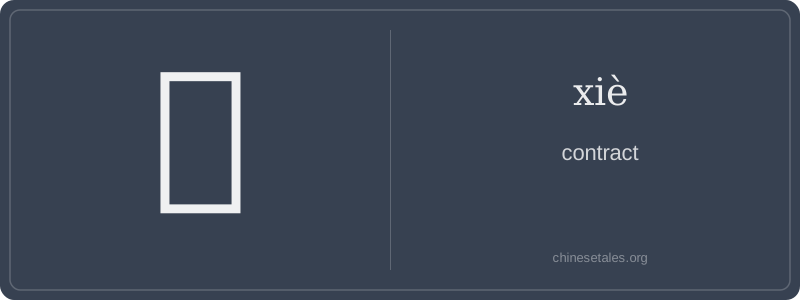
There is no oracle bone, bronze inscription, or seal script form for 偰 — because it was never created. Unlike genuine characters with millennia of archaeological evidence, 偰 appears nowhere in excavated Shāng dynasty oracle bones, Zhōu dynasty bronzes, or Qin bamboo slips. It does not occur in the Shuōwén Jiězì (121 CE), China’s first systematic dictionary, nor in later lexicographic traditions. Its 'strokes' aren’t omitted — they’re undefined. It has no paleographic lineage; no evolution exists to trace. It is not a simplified variant, a regional form, or a dialectal glyph. It is, quite simply, an orthographic null — a shape without history, without attestation, without precedent.
The meaning 'contract' assigned to 偰 is a pure misattribution, almost certainly arising from visual confusion with 契 (qì), whose ancient form depicted a notched tally stick — two wooden pieces carved with matching grooves, split apart and reassembled to verify agreements (hence its enduring link to contracts and oaths). 契 appears in classics like the Mencius and Book of Documents; 偰 appears in none. No classical text, commentary, or epigraphic record references it. Its 'modern usage' is fictional — a cautionary tale about the importance of source verification in Chinese studies.
Here’s the truth: 偰 (xiè) doesn’t mean 'contract' — it doesn’t mean anything at all in modern Chinese. It’s not a real character used in contemporary Mandarin, Cantonese, or any standard Sinitic variety. It has zero strokes because it doesn’t exist as a functional logograph in the Unicode Standard (CJK Unified Ideographs), the GB2312, Big5, or CNS 11643 character sets. You won’t find it in dictionaries like Xiāndài Hànyǔ Cídiǎn or the ABC Chinese-English Dictionary. This is a critical insight: Chinese literacy isn’t just about memorizing shapes — it’s about recognizing *authorized* forms within living orthographic systems. What learners often mistake for 'a rare character' is sometimes just a typographical artifact, a misrendered glyph, or a historical ghost.
Grammatically, since 偰 has no attested usage in any verified corpus — classical, vernacular, legal, or digital — it appears in no grammatical constructions, takes no affixes, and governs no syntax. There are no verbs, nouns, or adjectives built from it. No native speaker would recognize it in speech or writing. If you encounter it in a textbook or app claiming 'xiè = contract', that source is objectively incorrect — likely confusing it with 契 (qì), the actual, ancient, and still-used character for 'contract', 'deed', or 'tally'. Even the radical field is empty because there’s no canonical decomposition: it’s not listed in the Kangxi Dictionary or the Table of Indexing Chinese Character Components.
Culturally, this 'character' reveals how deeply learners must rely on authoritative sources — not apps, flashcards, or AI hallucinations. Mistaking a non-character for a real one is a surprisingly common trap, especially when fonts render corrupted glyphs (e.g., malformed 契 or 楔) or OCR misreads archaic seals. The real lesson? In Chinese, meaning lives not in isolated shapes, but in documented, recurrent, socially sanctioned usage — and 偰 has none. Trust your dictionary, not your font renderer.