偯
Character Story & Explanation
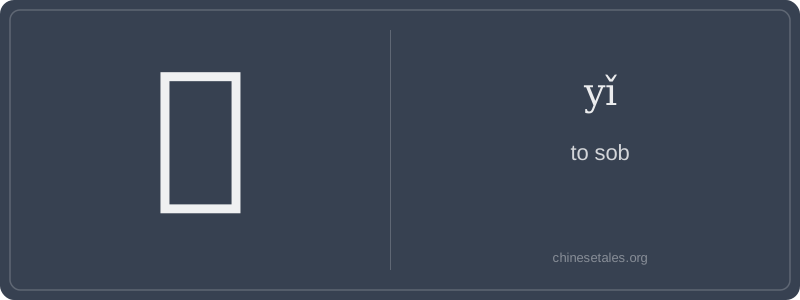
The earliest form of 偯 appears in bronze inscriptions (late Shang/early Zhou) as a compound: the left side was a variant of 口 (kǒu, 'mouth'), while the right was a stylized depiction of a person kneeling with arms crossed over the chest — a posture of deep mourning. Over centuries, the kneeling figure simplified into the phonetic component 以 (yǐ), which also provided the pronunciation, while 口 remained as the semantic indicator of vocalization. By the Small Seal Script era, the structure stabilized into today’s left-right layout: 口 + 以 — visually anchoring the act in the mouth, sonically anchored in the sound 'yǐ'.
This evolution mirrors its semantic journey: from depicting the physical posture of lamentation, it narrowed to focus exclusively on the *audible output* of that posture — the low, resonant, broken exhalations of sorrow. In the Classic of Poetry (Shījīng), 偯 appears in elegiac odes describing widows ‘sobbing without voice’ (偯而不号), highlighting its association with silent, internalized grief rather than outward cries. Its visual simplicity — just 口 + 以 — belies its emotional density: every time you see those two components, remember: mouth releasing the sound of a heart too full for words.
Imagine you’re at a quiet, rain-dampened funeral in an old Jiangnan courtyard — not the loud, wailing kind, but the hushed, breath-catching sobs that rise unbidden from deep in the chest: short, sharp, rhythmic, almost involuntary. That’s 偯 (yǐ) — not just 'crying', but the visceral, guttural sound of suppressed grief: a choked sob, a trembling exhalation between words. It’s deeply literary and emotionally precise, carrying the weight of sorrow too heavy for tears alone.
Grammatically, 偯 is almost always used as a verb in classical or literary contexts, often reduplicated as 偯偯 (yǐ yǐ) to intensify the rhythmic, repetitive nature of sobbing. You’ll rarely see it in modern spoken Mandarin or HSK materials — it appears mostly in poetry, historical narratives, or solemn prose (e.g., describing mourning rites). Crucially, it’s *not* used like 哭 (kū) — you don’t say '他偯了' casually; instead, it appears in set phrases like 偯偯而泣 or as a descriptive verb in parallel structures: '俯首而偯,掩面而泣' ('bowed head and sobbed, covered face and wept').
Culturally, 偯 reflects Confucian ideals of restrained yet profound emotion — grief expressed with dignity, not hysteria. Learners mistakenly treat it as a synonym for any crying verb, but its narrow semantic range (only *sound-based*, *rhythmic*, *involuntary sobbing*) makes it easy to misuse. Also, note: it’s tone 3 (yǐ), not tone 4 — mispronouncing it as yì could lead to confusion with other characters like 意 or 易.