偭
Character Story & Explanation
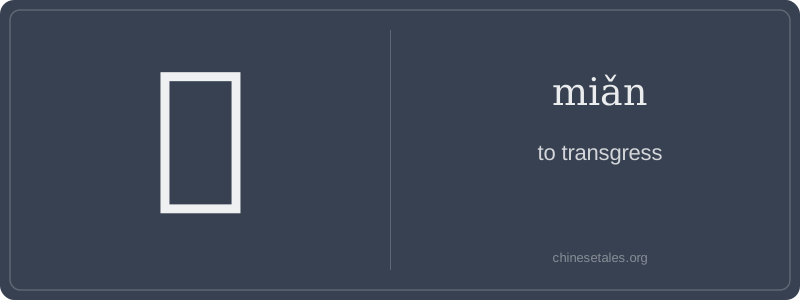
The earliest form of 偭 appears in Warring States bamboo slips as a composite character: left side 亻 (person radical), right side 免 — but not the modern 'exempt' 免. Its bronze script ancestor shows a kneeling figure (-like shape) beside a stylized head with a downward-sweeping stroke, suggesting 'bending away from upright conduct'. Over centuries, the head morphed into 免 (which itself evolved from a pictograph of a person removing a hat — a gesture of humility), while the person radical stabilized. By the Han dynasty, the structure solidified: 亻 + 免 = 'a person turning away from proper bearing'.
This visual logic became semantic truth: 偭 didn’t mean 'to break' but 'to turn one’s back on' — a physical metaphor for moral deviation. Mencius (Mengzi 6A:10) uses it to condemn rulers who 'turn away from benevolence' (偭仁), framing ethical failure as bodily orientation. Later, in the Classic of Filial Piety, it describes sons who 'turn away from ancestral rites' — their posture literally inverted, like someone walking backward down a sacred path. The character thus encodes ancient Chinese ethics as embodied geometry: virtue is facing forward; transgression is looking away.
Think of 偮 as the Chinese linguistic equivalent of 'crossing the Rubicon' — not just breaking a rule, but deliberately stepping over a sacred boundary with moral or cosmic weight. Unlike generic verbs for 'violate' (e.g., 违反), 偭 carries an archaic, almost liturgical gravity: it implies transgression against natural order, ancestral precedent, or heavenly principle (天理). You’ll almost never hear it in daily speech — it lives in classical texts, legal philosophy, and solemn admonitions.
Grammatically, 偭 is a transitive verb that *requires* an object — usually an abstract norm: 偭道 (transgress the Way), 偭礼 (defy ritual propriety), 偭法 (flout the law). It never stands alone like 'violate' can in English ('Don’t violate!'). Also, it’s almost always used in formal written contexts; using it in casual chat would sound like quoting Confucius at a coffee shop — unintentionally hilarious and deeply out of place.
Learners often misread it as mián (like 绵) or confuse its meaning with mere 'disobedience'. But 偭 isn’t about authority — it’s about harmony. In ancient cosmology, violating the Dao wasn’t rude; it was dangerous, like tuning a lute to the wrong pitch and risking the whole orchestra’s resonance. That’s why you’ll see it paired with words like 天常 (heavenly constancy) or 先王之制 (the former kings’ institutions) — not 'your mom’s rules'.