偫
Character Story & Explanation
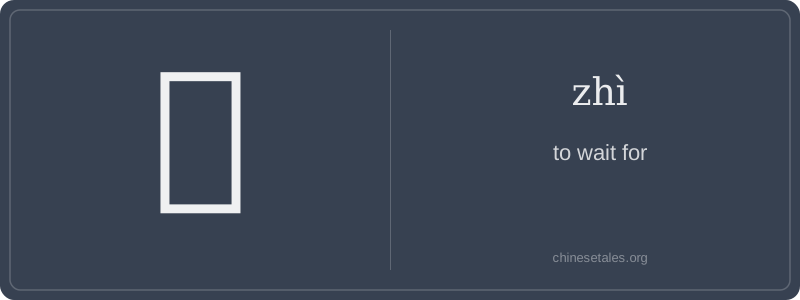
The earliest form of 偫 appears in Warring States bamboo texts (not oracle bones — it’s too late for that), showing a radical combining 口 (mouth/speech) and 耳 (ear) — but crucially, with a distinctive top component resembling 矢 (shǐ, 'arrow'), suggesting directed attention, like ears pricked and mouth poised to respond. Over centuries, the arrow evolved into the current top stroke group ( + 一 + 丶), while 口 and 耳 fused and stylized into the lower half — creating today’s elegant asymmetry. The character was never pictographic in the literal sense (no 'person waiting'), but ideographic: focused perception + prepared response.
This visual logic shaped its meaning: not idle waiting, but *attentive readiness*. In the Zuo Zhuan, 偫 describes statesmen 偫兵 ('preparing troops in anticipation of invasion'); in Han dynasty texts, it governs rituals — 偫祭 (zhì jì), 'readying sacrifices beforehand'. Its form whispers 'listen closely, speak only when needed, act only when time arrives.' Even today, calligraphers note how its balanced imbalance — heavy top, light base — mirrors the tension of poised expectation.
Think of 偫 (zhì) as Chinese’s ‘anticipatory pause’ — like the hush before a conductor raises the baton, or the breath you hold waiting for a text reply. It doesn’t mean ‘wait’ in the passive, clock-watching sense (that’s 等 děng); it means *to prepare and wait deliberately*, with readiness and purpose — often for something momentous: a guest, a harvest, a ritual, or fate itself. In classical usage, it carried gravitas: you didn’t 偫 coffee; you 偫 rites, 偫 tribute, 偫 the coming storm.
Grammatically, 偫 is almost always transitive and formal — it takes an object (what you’re waiting *for*), and rarely appears alone. You’ll find it in set phrases like 偫粮 (zhì liáng, 'store grain in anticipation') or 偫用 (zhì yòng, 'hold in reserve for future use'). Crucially, it’s not used in everyday spoken Mandarin — you won’t hear it on subway announcements or WeChat chats. Learners mistakenly plug it into modern sentences like '我在偫你' — which sounds like quoting a Zhou dynasty oracle, not making plans with a friend.
Culturally, 偫 embodies Confucian foresight and agrarian prudence: the virtue of preparing *before* need arises. Its near-total absence from modern speech makes it a linguistic fossil — beautiful, precise, and reserved for literary, historical, or ceremonial registers. Mistake it for 等 or 待, and you’ll sound either archaic or unintentionally poetic — like serving tea with a bronze ritual vessel instead of a mug.