偡
Character Story & Explanation
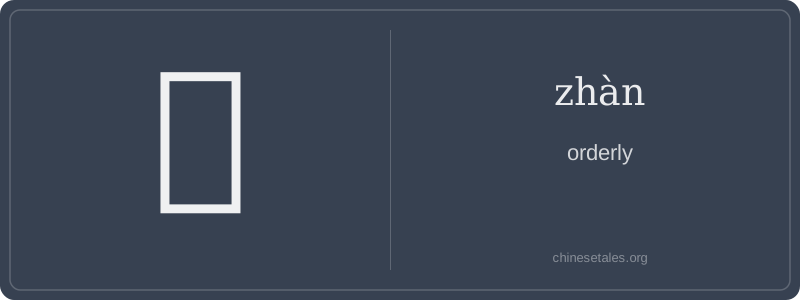
The earliest form of 偡 appears in bronze inscriptions as a compound pictograph: on the left, a simplified radical 亻 (person), and on the right, a stylized depiction of two hands holding a vertical staff or ritual scepter (now evolved into the component 占). This wasn’t just ‘a person standing’ — it was a ceremonial official maintaining ritual alignment, embodying the cosmic balance between heaven, earth, and human conduct. Over centuries, the right side morphed from a clear scepter-hand glyph into 占 (zhān), phonetically borrowed but visually anchoring the idea of ‘measured presence’.
By the Han dynasty, 偡 had crystallized in texts like the Shuōwén Jiězì as ‘orderly arrangement in accordance with ritual principle’ — not physical neatness, but moral and aesthetic congruence. In Tang poetry, Du Fu used 偡然 to describe the composed demeanor of sages facing chaos. Crucially, its visual structure — person + ‘occupy/measure’ (占) — reinforces that true order arises from mindful placement, not mere sorting. The character doesn’t depict objects lined up; it depicts *intention embodied*.
Imagine walking into a Ming-dynasty scholar’s study: inkstones aligned, brushes standing like silent soldiers in their holder, scrolls rolled with geometric precision — not a single paperclip out of place. That palpable, almost sacred stillness? That’s 偡 (zhàn): not just ‘orderly’ as in tidy, but *harmoniously arranged*, with quiet intention and aesthetic gravity. It evokes Confucian propriety — order that breathes, not order that clamps down.
Grammatically, 偡 is rare as a standalone adjective in modern speech; you’ll almost always find it in classical compounds or literary description, often modifying nouns like 风度 (bearing), 气象 (aura), or 步履 (gait). You wouldn’t say ‘the room is 偡’ — instead, you’d write 偡然有序 (zhàn rán yǒu xù) to describe a procession moving with dignified, unbroken rhythm. Learners mistakenly treat it like 整齐 (zhěngqí), but 偡 carries poetic weight — it’s the difference between ‘neat desk’ and ‘a Zen garden’s deliberate silence’.
Culturally, 偡 resonates strongest in historical texts and calligraphy critiques: a well-composed poem is 偡然成章; a master’s brushstroke sequence is 偡而不滞. Misusing it as a casual synonym for ‘tidy’ risks sounding archaic or unintentionally haughty. Its power lies in restraint — it’s never loud, never forced, and never appears in spoken Mandarin without deliberate stylistic intent.