偟
Character Story & Explanation
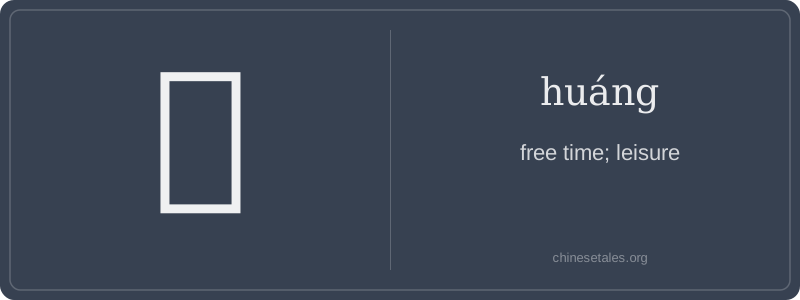
The character 偟 does not appear in oracle bone or bronze inscriptions—it’s a later creation, first attested in the Warring States bamboo texts and fully standardized by the Han dynasty. Its left radical 亻 (rén, 'person') anchors it in human experience, while the right side 皇 (huáng, 'august, sovereign') originally depicted a royal headdress with radiant plumes (⿱白王 in early forms). Over centuries, 皇 simplified from a pictograph of a crowned figure under heaven ( + 王) into today’s streamlined form—its top stroke elongating, middle horizontal shortening, and bottom stroke curving subtly. The combination suggests 'a person embodying sovereign calm'—not ruling, but radiating tranquil authority over time itself.
This meaning crystallized in the Zhuangzi, where 偟 appears in the phrase ‘彷偟乎尘垢之外’ (wandering freely beyond the dust and grime of worldly affairs)—describing the sage’s unattached, spacious mind. Later poets like Tao Yuanming used 悠偟 to evoke unhurried rural life: not laziness, but deliberate alignment with natural rhythm. Visually, the character’s balance—narrow left, broad right—mirrors its semantic tension: human scale (亻) holding vast, regal stillness (皇).
Think of 偟 (huáng) not as 'leisure' in the sense of Netflix and chill—but as the ancient Chinese equivalent of a perfectly blank, sun-dappled hour on your calendar: unclaimed, unhurried, and almost sacred in its emptiness. Unlike common words like 空闲 (kōngxián) or 闲暇 (xiánxiá), 偟 carries literary weight and poetic stillness—it’s the silence between temple bells, not the pause between Zoom calls. It’s rarely used in spoken Mandarin today; you’ll find it almost exclusively in classical poetry, calligraphy inscriptions, or highly stylized prose.
Grammatically, 偟 functions as a noun or adjective—never a verb—and almost always appears in fixed, elegant compounds like 悠偟 (yōu huáng, 'leisurely wandering') or 仿偟 (fǎng huáng, 'hesitant, wavering'). Crucially, it never stands alone in modern usage: you’d never say *‘我有偟’*—that would sound archaic or nonsensical. Instead, it’s embedded: ‘在悠偟中读诗’ (In leisurely stillness, I read poetry). Learners often mistakenly treat it like a synonym for 闲 and try to use it conversationally—like dropping 'verily' into a text message.
Culturally, 偟 evokes Daoist and Zhuangzian ideals of effortless being—wu wei (无为)—where true freedom isn’t activity, but the spaciousness before action. Its rarity in daily speech makes it a linguistic fossil: beautiful, precise, and utterly out of time. Mistake it for a functional word, and you’ll sound like someone quoting Shakespeare at a coffee shop—impressive, but deeply out of place.