偝
Character Story & Explanation
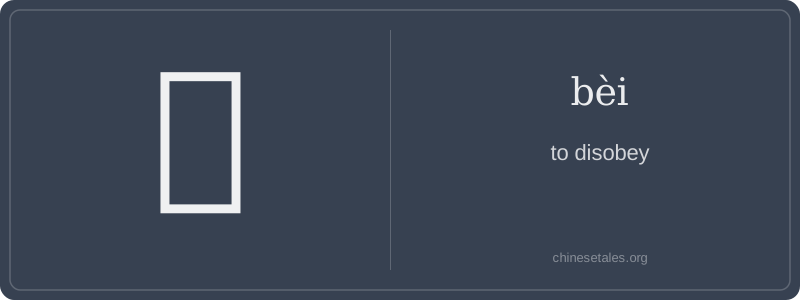
The earliest form of 偝 appears in bronze inscriptions as a composite pictograph: on the left, a variant of 背 (bèi, 'back'), showing a person with a prominent spine and bent posture; on the right, 北 (běi, 'north'), which originally depicted two people facing away from each other — symbolizing separation, opposition, and turning one’s back. Over centuries, the left side standardized into the 'person' radical (亻), while the right fused 北 into a stylized component, losing its literal 'two people' shape but preserving the semantic charge of deliberate reversal and estrangement.
This visual logic became philosophical truth: to 偝 is to turn your back — physically, relationally, ethically. In the Book of Rites (Lǐjì), 偝 appears in passages condemning ministers who 'bèi jūn ér shì rén' (turn their backs on the ruler to serve others), framing disloyalty as bodily inversion. Even today, the character’s structure whispers its meaning: 亻 + 北 = a person choosing north — the direction opposite home, duty, and alignment. It’s not just disobedience; it’s geographic, moral, and postural rebellion.
At its core, 偝 (bèi) carries the weight of moral rupture — not just 'disobeying rules,' but violating deep-rooted expectations of loyalty, filial piety, or trust. It’s a high-register, literary word rarely heard in casual speech; you’ll find it in classical texts, formal essays, or solemn admonitions — think 'betraying one’s teacher' or 'turning against ancestral principles.' Its tone is grave, almost archaic, and it implies intentionality and moral failure, not mere carelessness.
Grammatically, 停 is almost always transitive and requires an object: you 偝 someone or something — a person, principle, promise, or duty. You don’t say 'he bèi' alone; it’s always 'bèi shī fù' (disobey one’s master) or 'bèi xìn' (break faith). It never takes aspect particles like 了 or 过 in modern usage — that would sound jarringly colloquial. Also, avoid confusing it with passive constructions: 偝 is active and agentive — the subject *chooses* to betray.
Culturally, 偝 taps into Confucian ethics where relational integrity is sacred. Mistaking it for simpler verbs like 违反 (wéifǎn, 'to violate a rule') or 不听 (bù tīng, 'not listen') misses its ethical gravity. Learners often overuse it trying to sound 'advanced,' but native speakers reserve it for moments of profound moral collapse — like a minister abandoning his sovereign or a disciple rejecting his master’s core teaching. Using it for minor infractions (e.g., skipping homework) sounds comically dramatic — like calling a spilled coffee 'a treason against breakfast.'