偎
Character Story & Explanation
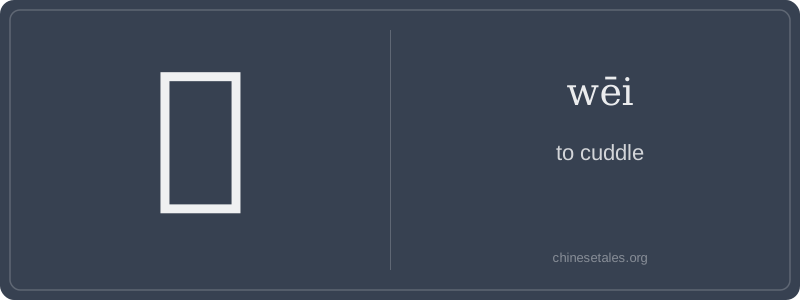
The earliest form of 偎 appears in seal script, where the left side was clearly the 人 (rén) radical—later simplified to 亻—and the right side was 威 (wēi), meaning 'power' or 'majesty', but here acting phonetically. Crucially, 威 itself evolved from a pictograph showing a woman (女) under a weapon-like glyph (戌), suggesting authority—but in 偎, that ‘power’ was repurposed purely for sound. Over time, the right side stabilized into today’s 威: three horizontal strokes (一 一 一), then 矢 (arrow) beneath, all enclosed in a box-like frame (戈 + 女 variant). The 11 strokes coalesced precisely to balance human closeness (亻) and resonant softness (威 as sound anchor).
By the Han dynasty, 偎 had shifted from rare classical usage (found in fragments like the Shuōwén Jiězì) to describe 'leaning upon' in a literal, architectural sense (e.g., a beam 偎柱) to a poetic metaphor for emotional reliance. In Tang poetry, Du Fu used 偎依 to depict refugees clinging to each other for survival—not romance, but raw human interdependence. Its visual structure reinforces this: the person (亻) literally leans into the stable, grounding shape of 威—like leaning against something solid, warm, and quietly powerful.
At its heart, 偎 (wēi) isn’t just ‘to cuddle’ in the Western sense of playful or romantic snuggling—it carries a quiet, tender weight: leaning into warmth for comfort, safety, or solace. Think of a child nestling against a parent’s side during thunder, or an elder resting their head on a grandchild’s shoulder—this is 偎: gentle, reciprocal, and deeply intimate without being sexual. It implies physical proximity rooted in emotional trust, not excitement.
Grammatically, 偎 is almost always used as a verb in compound structures like 偎着 (wēi zhe, 'leaning/cuddling against') or 偎依 (wēi yī, 'to lean on each other for support'). You’ll rarely see it alone—it needs a complement: 偎着妈妈 (wēi zhe māma, 'cuddling up to Mom'), not *偎妈妈. It’s also nearly always transitive (requires an object), and never used reflexively ('cuddle oneself') or in passive constructions. Learners often mistakenly use it like English 'cuddle' with abstract nouns (e.g., *偎爱情)—but no: you only 偎 people or tangible things that offer warmth or shelter (a fire, a wall, a blanket).
Culturally, 偎 reflects the Chinese value of embodied care—affection expressed through subtle, grounded presence rather than grand declarations. It appears in classical poetry describing lovers, but more often in modern prose depicting familial tenderness or quiet resilience. A common error? Confusing it with 拥 (yōng, 'to embrace')—which is broader, more active, and can be ceremonial or political (e.g., 拥抱新时代). 偎 is smaller, softer, and far more personal: it’s the whisper before the hug.