偌
Character Story & Explanation
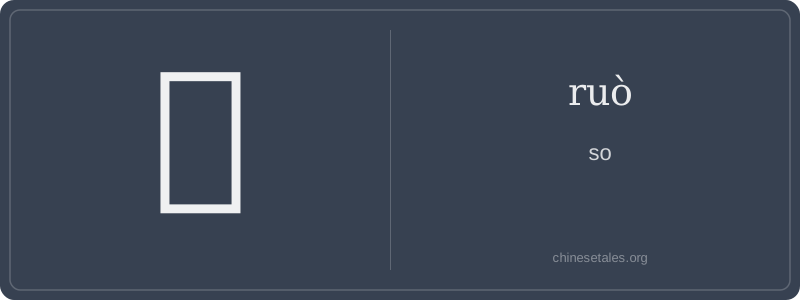
偌 evolved from the ancient character 若 (ruò), which originally appeared in oracle bone script as a stylized depiction of a woman with drooping hair and hands clasped — symbolizing humility or compliance. Over time, the top part simplified into 艹 (grass radical) and the bottom into 口 (mouth), while the human element was preserved in the left-side 亻 (person radical) added later to emphasize agency or perspective — turning 'if/compliance' into 'so (as perceived by a person)'. The modern form stabilizes around the Han dynasty, with its 10 strokes carefully balancing the upright 亻 and the flowing, slightly sprawling right side (若).
This visual shift mirrors a semantic deepening: 若 originally meant 'if' or 'like', but when prefixed with 亻, it acquired a deictic, embodied force — 'so (as *I* see it)' or 'such (in *this* human context)'. By the Tang and Song dynasties, 偌 appears in poetry and prose to amplify scale with quiet authority: Du Fu might lament 偌大天地 (so vast a heaven-and-earth), implying both awe and existential smallness. The 亻 doesn’t just mean 'person' — it anchors the magnitude in human perception, making 偌 less about objective size and more about subjective impact.
偌 is a literary, emphatic intensifier meaning 'so' or 'such' — think of it as the Chinese equivalent of 'so huge!' or 'such a mess!' in dramatic storytelling. It’s not used in casual speech or beginner textbooks (hence its absence from HSK), but appears frequently in novels, essays, and formal writing to magnify scale, degree, or emotional weight — always paired with a noun or adjective (e.g., 偌大, 偌多). Unlike colloquial 'zhème' (这么), 偌 carries gravitas: it implies awe, irony, or even gentle sarcasm ('So *much* paperwork? Really?').
Grammatically, 偌 functions only as a pre-nominal modifier — never alone, never before verbs, and never in questions or commands. You’ll see it in fixed two-character compounds like 偌大 (ruò dà, 'so large') or 偌多 (ruò duō, 'so many'), where it always precedes the descriptive word. A common learner mistake is trying to use it like 是…的 structure or inserting it mid-sentence — but 偌 must cling tightly to its head noun, like an old-fashioned poetic adjective that refuses to budge.
Culturally, 偌 echoes classical rhetorical flair: it’s the character you’d find in Lu Xun’s satirical essays ('偌大的中国,竟容不下一张安静的书桌!') or in historical dramas when a general surveys his army and sighs, '偌多将士…'. Its rarity today makes it a subtle marker of linguistic sophistication — like dropping 'verily' into English. Learners who master it gain access to richer narrative textures, but misuse risks sounding archaic or unintentionally theatrical.