偃
Character Story & Explanation
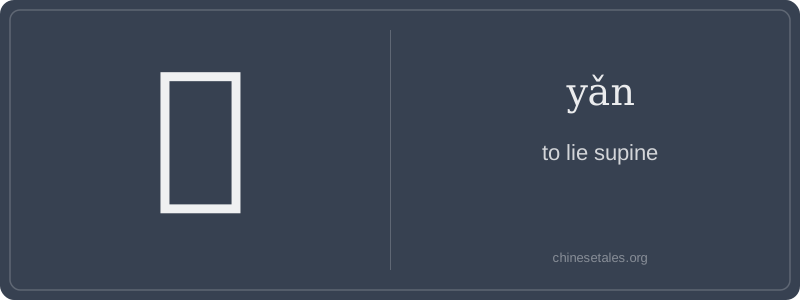
The earliest form of 偃 appears in bronze inscriptions as a person (亻) with arms raised and head tilted back, lying supine — a stylized figure reclining on a mat, legs extended, torso arched slightly upward. Over time, the upper part evolved: the original 'head-and-arms' element simplified into the component 掩 (yǎn), which itself means 'to cover' or 'to conceal', reinforcing the idea of being face-up and exposed — vulnerable, still, covered only by sky. The left radical 亻 stayed firm, anchoring the human subject, while the right side solidified into 掩’s simplified form — 11 strokes total, balancing weight and stillness.
This visual logic shaped its meaning: from literal 'lying on back' to metaphorical 'cessation' — if you lie supine, you stop moving; if an army ‘lowers banners and silences drums’, it lies dormant. Confucius’s Analects (17.5) uses 偃 in the phrase ‘道之以政,齊之以刑,民免而無恥;道之以德,齊之以禮,有恥且格’ — though not directly, later commentators applied 偃 to describe the ‘quieting’ of unrest through virtue. Its power lies in restraint: no force needed — just the posture of stillness, and the world settles.
Think of 偃 like the Chinese equivalent of 'supine' in medical English — precise, formal, and slightly archaic. It doesn’t mean just 'lying down' (that’s 躺), but specifically lying flat on one’s back, often motionless, passive, or even defeated. In Classical Chinese, it evokes images of surrender: a fallen general, a toppled banner, or a body laid out for ritual. That nuance is crucial — learners who substitute 偃 for 躺 risk sounding like they’re quoting a Tang dynasty elegy instead of ordering lunch.
Grammatically, 偃 is almost never used alone in modern speech; it appears mainly in literary compounds or set phrases (e.g., 偃旗息鼓). When it does appear verb-like, it’s typically in passive, descriptive constructions: 'the banner was lowered' → 旗偃, not 'I am lying down'. It’s a stative verb — more about state than action — and almost always requires context to avoid sounding unnatural or poetic to the point of obscurity.
Culturally, 偃 carries quiet gravity: it’s the character used in the famous idiom 偃旗息鼓 (literally 'lower banners, silence drums'), meaning to cease hostilities or withdraw quietly — a strategic retreat, not a collapse. Learners often misread its radical (亻) as implying 'person doing something', but here it signals 'human posture' — not agency, but orientation. Mispronouncing it as yàn (like 燕) is common, but that tone shift changes nothing — because yàn isn’t even a valid reading for this character!