倻
Character Story & Explanation
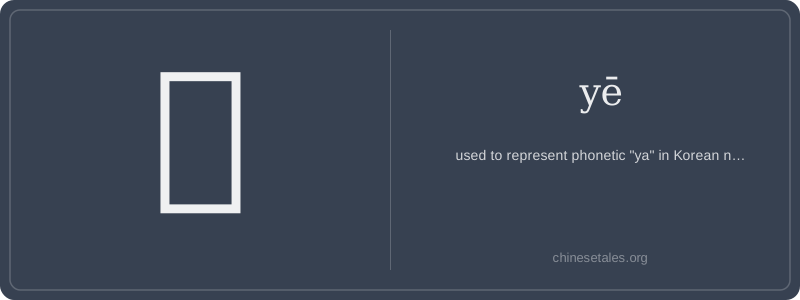
The character 倻 is not ancient — it has no oracle bone or bronze script form. It was formally standardized in the 1970s by the Chinese Academy of Social Sciences as part of the 'Table of Standardized Chinese Characters for Korean Name Transcription'. Visually, it merges the 亻 (person) radical — signaling human naming — with 世 (shì, 'generation, world'), which provides both phonetic approximation (shì → yē via dialectal softening and tone shift) and semantic weight ('a person of this generation'). Its ten strokes were carefully chosen: 2 for 亻, 8 for 世 — clean, unambiguous, and distinct from similarly shaped characters like 代 (dài) or 泄 (xiè).
Unlike characters that evolved organically over millennia, 倻 was engineered. It appears nowhere in classical texts — no Confucius, no Tang poetry, not even in the Kangxi Dictionary. Its entire life began in bureaucratic linguistics: to solve the problem of rendering Korean '야' (ya) without resorting to homophonous but semantically loaded characters like 耶 (yē, an interrogative particle) or 也 (yě, 'also'). By anchoring it visually to 世 — a character associated with lineage and continuity — its designers subtly reinforced the idea that Korean names belong within China’s civilizational framework, not as foreign noise but as kinship across script boundaries.
Imagine you’re proofreading a bilingual Korean-Chinese dictionary in Beijing, and you spot the name 'Yeo Jin-woo' rendered as 倻진우 — wait, that first character looks odd. You double-check your dictionary app: yes, it’s 倻 (yē), not the more familiar 叶 (yè) or 夜 (yè). This character doesn’t mean anything in Chinese — it’s a linguistic passport stamp. It exists solely to transcribe the Korean syllable 'ya' (as in Yae, Ya, or sometimes Ye) in names like 倻美子 (Yā Měizǐ) or 倻承俊 (Yā Chéngjùn). Think of it as Chinese orthography’s designated 'Korean sound booth' — silent in native speech but indispensable for accurate romanization-free rendering.
Grammatically, 倻 appears only as the initial syllable in proper nouns — never in verbs, adjectives, or standalone words. You’ll never see it in a phrase like '倻地' or '倻了', because it has zero semantic function. Its usage is strictly phonetic and bound to Korean personal names or rare historical transliterations (e.g., old maps of Jeju Island). Learners often mistakenly treat it like 叶 (yè, 'leaf') or 椰 (yē, 'coconut'), leading to comical misreadings — imagine calling a Korean colleague 'Coconut Jun' instead of 'Ya Jun'!
Culturally, 倻 reflects China’s pragmatic approach to linguistic borrowing: rather than force foreign sounds into existing characters, lexicographers created (or revived) ultra-niche glyphs with minimal stroke count and maximal phonetic fidelity. It’s not taught in schools, rarely appears outside official documents or ID cards, and even many native speakers have never typed it — they rely on input method shortcuts like 'yekorean'. Its invisibility is its superpower: it does one job, perfectly, and stays out of the way.