倷
Character Story & Explanation
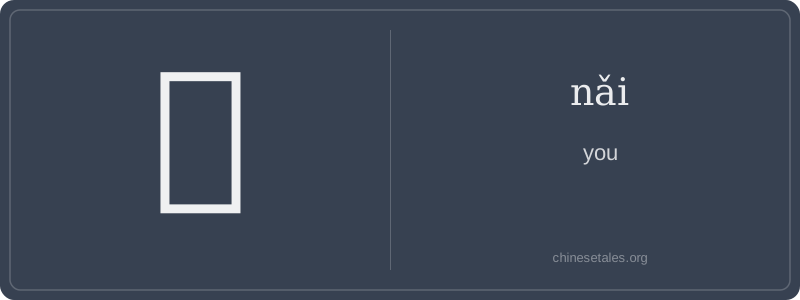
The character 倷 has no oracle bone or bronze script ancestry — it’s a relatively recent phonetic-semantic compound invented in late imperial or early Republican times to write the Wu dialect pronoun /ŋɛ/ or /nɛ/. Visually, it merges the radical 亻(person) with the phonetic component 尔 (ěr, meaning ‘you’ in classical Chinese), but with a deliberate simplification: 尔’s upper part (冂 + 八) is reduced to two dots, yielding 倷’s distinctive top-right cluster. This wasn’t evolution — it was dialectal orthographic engineering, a grassroots effort to pin down spoken sound with familiar components.
Its meaning stayed remarkably stable: always second-person singular, always informal and familiar — never honorific, never plural. Unlike classical 尔 or 汝, 倷 never appeared in Confucian texts or imperial edicts; instead, it surfaced in Qing-era Wu opera scripts, early 20th-century Shanghai vernacular fiction, and oral folk rhymes. The shape itself whispers its function: 亻 anchors it as ‘person,’ while 尔’s ghostly echo ties it to classical ‘you’ — yet the streamlined dots signal its modern, colloquial, unpretentious soul.
Here’s the twist: 倷 (nǎi) isn’t a standard Mandarin character at all — it’s a regional pronoun from Wu Chinese dialects, especially Shanghainese and Suzhounese. Forget textbook ‘you’ (nǐ); 倷 is the warm, gritty, locally rooted ‘you’ you’d hear in a noodle shop near the Bund or a teahouse in Pingjiang Road. It carries intimacy, informality, and a gentle regional pride — never used in formal writing, official speech, or national broadcasts. You won’t find it in dictionaries unless they specialize in dialect lexicography.
Grammatically, 倷 functions exactly like nǐ: subject, object, even possessive when paired with 的 (e.g., 倷个书 — ‘your book’). But crucially, it’s *not* interchangeable with nǐ — dropping 倷 into a Beijing conversation would cause polite confusion, like saying ‘y’all’ to a London banker. Learners sometimes misread it as a variant of 你 due to visual similarity, but that’s a red flag: no native Mandarin speaker uses 倷. Its usage is strictly oral, local, and context-bound — think ‘dialect passport,’ not ‘HSK vocabulary.’
Culturally, 倷 embodies linguistic resilience: while Mandarin standardization pushed many regional forms aside, 倷 thrives in daily life, pop songs, and WeChat voice notes among Wu speakers. A common mistake? Assuming it’s an archaic literary form — it’s not ancient; it’s vibrantly alive, just geographically specific. And yes, its stroke count is zero in standard stroke-order systems because it’s absent from the GB2312 and Unicode’s basic CJK set until very recently (Unicode 13.0, 2020) — a quiet rebellion against digital homogenization.