倨
Character Story & Explanation
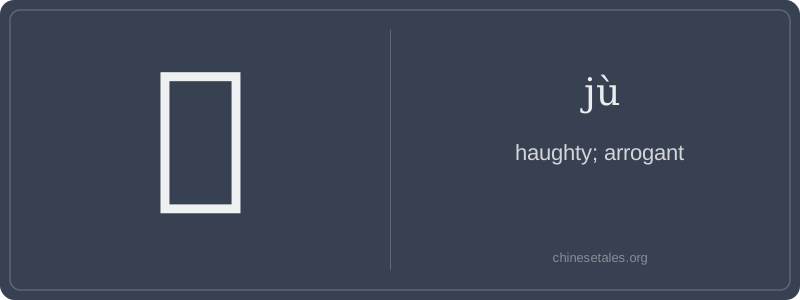
The earliest form of 倨 appears in bronze inscriptions as a composite: the left side was 人 (rén, person), and the right side depicted a bent knee and extended foot — not walking, but *standing rigidly upright*, with weight shifted back and chest thrust forward. Over centuries, the foot element simplified into 居 (jū, 'to dwell'), which phonetically reinforced the sound jù while preserving the sense of 'taking stance'. By the Han dynasty clerical script, the human radical 亻 stabilized on the left, and the right evolved into the modern 居 — no longer pictographic, but still semantically anchored in 'occupying space with authority'.
This visual logic shaped its meaning: from physical posture to moral bearing. In the Zuo Zhuan, 倨 describes feudal lords who ‘stand aloof’ from ritual obligations — their arrogance isn’t emotional but embodied, a refusal to kneel during ancestral rites. Later, in Tang poetry, it gained psychological depth: Li Bai used 倨肆 to depict unrestrained genius — not rude, but so self-assured it bypassed convention entirely. Crucially, the character’s structure — 亻+居 — quietly suggests 'a person dwelling in their own elevated position', making the arrogance feel architectural, not impulsive.
Think of 倨 (jù) as the Chinese equivalent of a raised eyebrow paired with crossed arms — not shouting, but radiating quiet, unshakeable superiority. It’s not just 'arrogant' like the English word; it carries a classical, almost theatrical disdain — the kind you’d see in a Ming dynasty scholar refusing to bow to a newly rich merchant. This isn’t slang or casual speech: 倨 appears almost exclusively in literary contexts, set phrases, or formal criticism. You’ll rarely hear it in daily conversation, but you’ll see it in essays condemning political hubris or describing a haughty aristocrat in historical fiction.
Grammatically, 倨 is an adjective that *only* appears before nouns (e.g., 倨慢, 倨傲) or in fixed two-character compounds — never alone as a predicate (*He is jù* is ungrammatical). It never takes aspect particles (了, 过) or degree adverbs like 很. Instead, it pairs tightly with other classical adjectives: 倨傲 (jù ào), 倨慢 (jù màn), or 倨肆 (jù sì). Learners often mistakenly try to use it like modern adjectives — say, *tā hěn jù* — but that construction simply doesn’t exist in standard Mandarin.
Culturally, 倨 evokes Confucian discomfort with self-aggrandizement — it’s less about confidence and more about violating the relational harmony (hé) central to Chinese ethics. A common error is confusing it with modern colloquial terms like 酷 (kù, 'cool') or 装 (zhuāng, 'to pretend'); 倨 isn’t performative — it’s structural, baked into posture, tone, and refusal to yield. Its rarity outside written language makes it a subtle litmus test: if you spot 倨 in a text, you’re reading something deliberately elevated — or someone being very, very carefully condemned.