倥
Character Story & Explanation
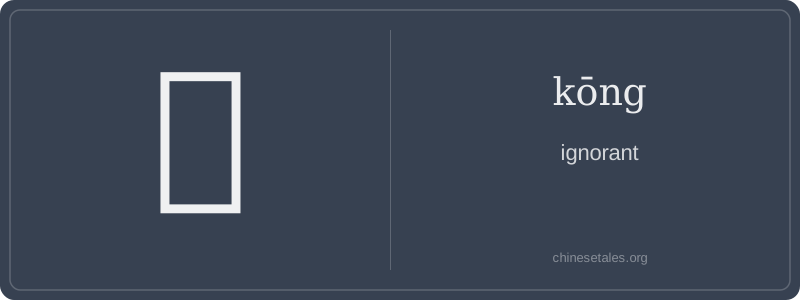
Oracle bone inscriptions don’t show 倥 — it emerged later, during the Warring States period, as a phono-semantic compound. The left side 亻 (rén bàng) signals 'person', while the right side 空 (kōng) serves both sound and meaning: its hollow shape evokes emptiness, and its pronunciation anchors the character. Early seal script shows 空 clearly — a roof (宀) over a hole (工), suggesting 'void beneath shelter'. Over centuries, the roof simplified, the 'hole' became 工, and the person radical stabilized on the left — ten strokes total, each one a deliberate echo of human incompleteness.
This visual logic shaped its meaning: a person whose inner space is 'empty' — not of intelligence, but of cultivated knowledge or moral awareness. In the Book of Rites (Lǐjì), 倥 appears in phrases like 倥蒙 (kōng méng), describing children before rites and learning fill their minds. Later, Tang poets used it metaphorically — e.g., 'a 倥 mountain mist' implying obscurity not from darkness, but from unpenetrated understanding. Its form is a quiet lesson: ignorance isn’t chaos; it’s a clean, open space waiting for light.
Think of 倥 (kōng) as the quiet, old-fashioned cousin of 'ignorant' — not rude or dismissive like 'stupid', but carrying a gentle, almost literary weight of 'uninformed through lack of exposure'. It’s rarely used in daily speech; you’ll mostly meet it in classical texts, formal essays, or poetic criticism — like saying someone is 'culturally uninitiated' rather than 'clueless'. Its core feeling is soft deficiency: an absence, not a flaw.
Grammatically, 倥 functions almost exclusively as an adjective before nouns (e.g., 倥蒙 — 'ignorant and unenlightened') or in fixed two-character compounds. You won’t say '他很倥' — that’s unnatural. Instead, it appears in set phrases like 倥蒙未启 (kōng méng wèi qǐ), meaning 'the mind has not yet been awakened' — often describing childhood innocence or pre-education states. Unlike common adjectives like 无知 (wúzhī), 倥 feels archaic and lyrical, never blunt.
Culturally, learners often misread it as related to 空 (kōng, 'empty'), especially since they share pronunciation and stroke count. But while 空 is neutral or philosophical, 倥 carries subtle moral resonance — Confucian texts use it to describe minds lacking ethical cultivation, not just factual knowledge. A classic mistake? Using 倥 alone as a standalone descriptor — it’s nearly always paired, never solo. And yes, it *can* be pronounced kǒng (e.g., in rare dialectal or historical readings), but kōng is the standard literary reading you’ll encounter.