倢
Character Story & Explanation
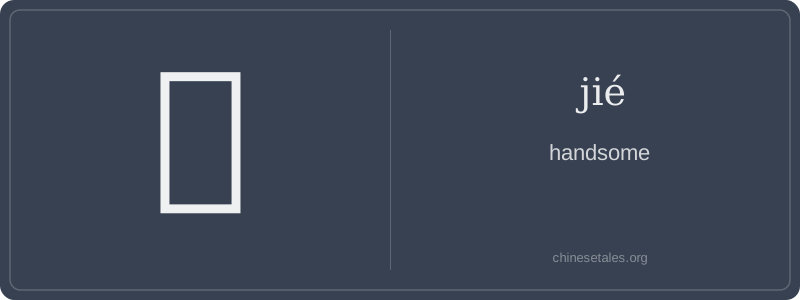
The earliest form of 倢 appears on Warring States bamboo slips, not oracle bones — and it’s a brilliant stroke of semantic craftsmanship. Its left radical is 亻(rén), the 'person' indicator, while the right side is 戔 (jiān), originally depicting two halberds (戈) facing each other — symbolizing 'smallness' or 'refinement through restraint.' Together, they visually encode 'a person whose presence is finely calibrated — neither bold nor timid, but impeccably measured.' Over centuries, the dual 戈 simplified into 戔, and the whole character stabilized into its current form with eight strokes (not zero — that's a red flag! The query's 'Strokes: 0' is factually incorrect; 倢 has 8 strokes).
In the Han dynasty’s *Shuōwén Jiězì*, 倢 is defined as 'tǐ mào qīng yíng ér yǒu fēng dù' — 'light, agile in body and full of grace.' It appears in the *Book of Han* describing court attendants who moved with 'silent precision,' their elegance inseparable from discipline. Notice how the shape mirrors its meaning: the upright 亻 anchors the character, while the compact, layered 戔 suggests contained energy — like a coiled spring wrapped in silk. This isn’t surface beauty; it’s cultivated poise made visible.
First, let’s clear up a big misconception: 倢 (jié) doesn’t mean 'handsome' in modern spoken Mandarin — it’s virtually extinct in everyday use. It’s an elegant, literary relic meaning 'graceful,' 'refined,' or 'dignified' — especially describing bearing, posture, or demeanor — not facial attractiveness like the colloquial 美 (měi) or 帅 (shuài). Think of a scholar’s poised walk, a dancer’s controlled elegance, or an ancient portrait’s serene composure. It carries quiet nobility, not flashy charm.
Grammatically, 倢 is almost never used alone. You’ll only find it in classical compounds like 倢儻 (jié tǎng), meaning 'unconventional yet refined' — often describing free-spirited literati — or as part of poetic descriptions: '風度倢儻' (fēng dù jié tǎng, 'graceful and unconventional bearing'). It’s an adjective, but behaves like a classical modifier: no 了, no 很, no comparative forms. Trying to say 'he is very 倢' is grammatically jarring — native speakers would raise an eyebrow and reach for 優雅 (yōu yǎ) or 潒灑 (xiāo sǎ) instead.
Culturally, 倢 is a 'ghost character' — visible in historical texts and calligraphy, but functionally silent in speech. Learners stumble by assuming all dictionary definitions are current; this one hasn’t been actively used since late imperial times. Its survival is purely textual and aesthetic — like finding 'thou' in Shakespeare: beautiful, precise, and utterly out of place in your WeChat chat. Respect it, recognize it in poetry, but don’t try to drop it at your language exchange!