倝
Character Story & Explanation
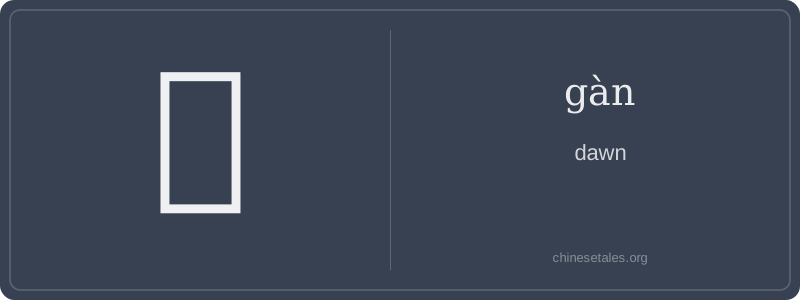
The earliest form of 倝 appears in late Shang oracle bone inscriptions as a striking pictograph: two rising suns (or sun-and-moon motifs) above a kneeling human figure (the 人 radical), sometimes flanked by stylized rays or vapor lines. Over centuries, the dual celestial bodies fused into the upper component 干 (gān, 'dry' or 'pole'), while the kneeling person evolved into the simplified 人 radical — retaining the sense of a human witnessing the sky’s transformation. The ten strokes crystallized during the Han clerical script period, balancing symmetry and ritual gravity.
By the Warring States era, 倝 shed its literal 'two suns' reading and solidified as 'first light' — the precise instant when yang energy begins to stir. It appears in the *Chu Ci* (Songs of Chu) describing the shaman’s journey 'at 倝, before the rooster crows', marking liminality as spiritually potent. Visually, the upright 干 (like a pole holding up heaven) over 人 suggests humanity standing beneath the first breath of light — not conquering dawn, but receiving it. That posture — reverent, still, attentive — remains encoded in every stroke.
倝 is a poetic, almost archaic word for 'dawn' — not the everyday 'morning' (早上) or 'sunrise' (日出), but that hushed, luminous threshold when night yields to light. It carries a literary weight and quiet reverence, evoking stillness, transition, and cosmic order. In classical Chinese, it often appears in parallel with dusk (昏) or moonlight (月), framing time as a sacred rhythm rather than a clock-ticked commodity. You won’t hear it in subway announcements or weather apps — but you’ll find it in Tang dynasty poems and modern essays on nature aesthetics.
Grammatically, 倝 functions almost exclusively as a noun or temporal noun phrase, rarely as a verb or modifier. It’s not used predicatively ('It is dawn') like 是 dawn — instead, it appears in subject position ('倝色微明') or after prepositions ('于倝时'). Learners sometimes wrongly treat it like a verb stem ('to dawn') or confuse it with the more common 晗 (hán), but 倝 has no verbal usage — it names the moment itself, not the action of dawning. Its ten-stroke structure hides zero phonetic clues: gàn is purely traditional pronunciation, unrelated to its components.
Culturally, 倝 reflects how early Chinese cosmology centered on luminous thresholds — not just light, but the *edge* where darkness recedes. This character rarely appears alone; it thrives in compound elegance (e.g., 倝色, 倝光). Mistake it for a simple synonym of 早晨? You’ll sound like someone quoting Confucius at a coffee shop — charming, but wildly out of register. Its rarity makes it a litmus test: if you use 倝 correctly, you’re reading beyond textbooks — you’re listening to the silence before birdsong.