倜
Character Story & Explanation
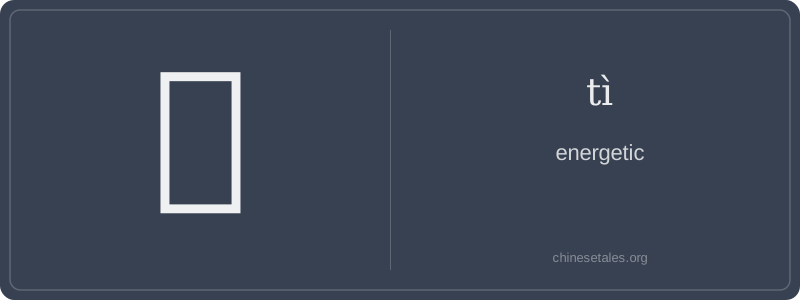
The earliest form of 倜 appears in seal script as a combination of 亻 (person radical) and 周 (zhōu, originally depicting a field enclosed by walls, later meaning ‘all-around, complete’). The bronze inscription version shows a figure with arms raised mid-gesture — not fighting, but gesturing expansively, embodying full-bodied presence. Over time, the right side simplified from 周 to its modern 10-stroke form: the top two horizontal strokes (一 一), then the ‘mouth’-like 口, then the crossbar and vertical stroke below — all evoking rhythmic, controlled motion rather than chaos.
This visual logic shaped its meaning: 倜 isn’t raw vigor — it’s *complete* personhood in action. By the Han dynasty, it crystallized in the compound 倜傥, used by Sima Qian to praise figures who combined moral integrity with effortless charm and strategic boldness. The character’s enduring power lies in this fusion: the ‘person’ (亻) fully animated by ‘completeness’ (the essence of 周), making 倜 the rare character that means ‘alive in the best possible way’ — not just energetic, but *elegantly whole*.
Imagine a young scholar in Tang-dynasty Chang’an, striding across the imperial examination courtyard — not nervous, but radiating vibrant readiness: shoulders back, eyes bright, robe fluttering just so. That’s 倜 (tì): not just ‘energetic’ in a generic sense, but a refined, almost aristocratic vitality — poised, alert, and gracefully dynamic. It’s the energy of someone fully *in their element*, not panting after a sprint, but luminous before a performance.
Grammatically, 倜 almost never stands alone. You’ll nearly always see it paired — most famously in 倜傥 (tì tǎng), meaning ‘unconventional yet charismatic’ or ‘free-spirited and dashing’. It’s an adjective that modifies people (especially men in classical contexts), ideals, or styles — never objects or abstract concepts like ‘energy’ itself. Learners sometimes misread it as ‘tired’ (tì sounds like tì in 疲惫) or overuse it like English ‘energetic’, but 倜 carries literary weight; you’d never say 倜的咖啡 (‘energetic coffee’) — it’s deeply human-centered and culturally loaded.
Culturally, 倜 is a quiet relic of elite literati aesthetics. In texts like the Shiji, 倜傥 describes heroes like Lord Xinling — noble, quick-witted, effortlessly commanding. Modern usage is rare outside set phrases or poetic registers; hearing it in daily speech feels like spotting a crane in a city park: elegant, unexpected, and unmistakably classical.