倚
Character Story & Explanation
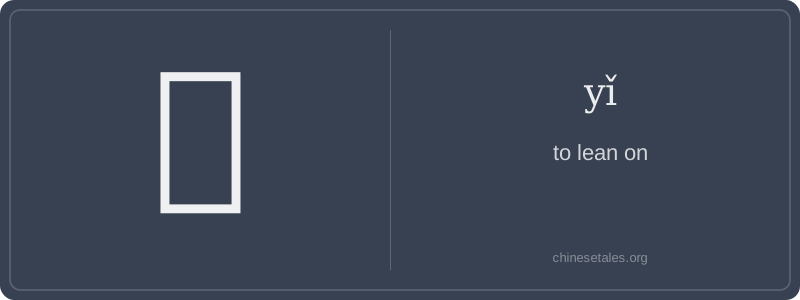
The earliest form of 倚 appears in Warring States bamboo texts as a compound: left side 亻 (person), right side 異 (yì, 'different' — originally a person with a mask or unusual headdress). But crucially, in early variants, the right component resembled a bent arm supporting something overhead — not just difference, but *supportive posture*. Over centuries, 異 simplified visually into the modern 口 + 田 + 廾 shape we see today, but the core idea of 'person + supportive structure' held firm. The ten strokes now map neatly: two for 亻, eight for the right side — and that eighth stroke, the downward hook of the bottom 'hands' (廾), literally grounds the leaning motion.
This character blossomed in classical literature: in the Book of Songs, 倚 describes mourners leaning on tomb mounds; in Du Fu’s poetry, it evokes the frail elder leaning on his cane beneath autumn trees. Even today, the visual logic remains potent: the 亻 radical leans *into* the right component — as if the person is physically tilting toward the structure beside them. That subtle diagonal tension between the two halves isn’t accidental; it’s calligraphy capturing physics — balance, gravity, and quiet reliance in a single, elegant asymmetry.
At its heart, 倚 (yǐ) is about physical and metaphorical support — the quiet intimacy of leaning: on a balcony rail, against a friend’s shoulder, or even on tradition for moral authority. It’s not passive slouching (that’s 趴 or 躺), nor is it aggressive dependence (that’s 依 or 靠 in some contexts); 倚 carries a subtle elegance, a momentary, conscious shift of weight — often with poetic or literary resonance. You’ll rarely hear it in casual spoken Mandarin (hence its absence from HSK), but it thrives in classical allusions, descriptive writing, and fixed expressions like 倚门而望 ('waiting by the gate, leaning').
Grammatically, 倚 is almost always transitive and requires an object — you *lean on* something: 倚着墙 (yǐ zhe qiáng), 倚在窗边 (yǐ zài chuāng biān). Note the particle 着 (zhe) for ongoing action, or 在 (zài) for location — learners often omit these and produce unnatural strings like '我倚墙', which sounds like a terse oracle, not a human sentence. Also, avoid using 倚 alone as a verb in commands ('Lean here!') — native speakers prefer 靠 or 挨 in speech.
Culturally, 倚 evokes refined stillness — think of Tang dynasty poets leaning on balustrades to gaze at mountains, or elderly parents leaning on doorframes watching children leave. Its rarity in daily speech makes it a 'flavor note': deploy it once in a composition and it adds texture, gravitas, even melancholy. A common mistake? Confusing it with 易 (yì, 'easy') due to similar pronunciation — but their meanings and forms are worlds apart. Remember: 倚 is about weight shared; 易 is about effort avoided.