倓
Character Story & Explanation
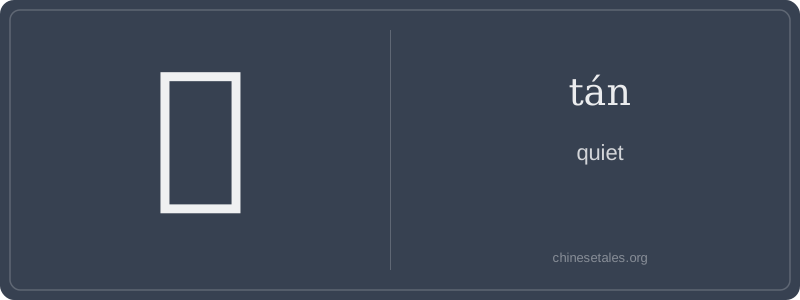
The earliest form of 倓 appears in seal script (c. 3rd century BCE), where it clearly combines the radical 亻 (rén, 'person') on the left with the phonetic component 旦 (dàn, 'dawn'). But look closer: 旦 itself is a pictograph of the sun (日) rising over the horizon (一) — symbolizing clarity, beginning, and natural order. In 倓, this wasn’t just about sound; it visually suggested a person embodying the calm, luminous stillness of first light — not passive silence, but alert, centered presence.
By the Han dynasty, 倓 solidified into its modern structure: 亻 + 旦. Classical texts like the *Zhuangzi* and Song-era poetry used it to describe sages who remained 倓然不动 ('still and unmoved') amid chaos — their quietness was ethical fortitude, not mere absence of noise. The character never acquired verb or noun usages because its power lies precisely in its immovable adjectival essence: it names a state so complete, it resists grammatical transformation. That’s why, even today, seeing 倓 feels like encountering a brushstroke from a Song landscape painting — minimal, resonant, and deeply intentional.
倓 is a rare, elegant character meaning 'quiet', 'serene', or 'calm' — but not the everyday quiet of 静 (jìng) or 安 (ān). Think of it as the hushed reverence in an ancient temple courtyard at dawn, or the deep stillness after snowfall: a quiet that feels both moral and atmospheric. It carries a classical, almost literary weight — you won’t hear it in casual speech or beginner textbooks, and it’s absent from the HSK lists for good reason: it’s reserved for poetic, philosophical, or ceremonial contexts.
Grammatically, 倓 functions almost exclusively as an adjective, often in compound words (e.g., 倓然, 倓泊), and rarely stands alone. Unlike 静, which can be a verb ('to quiet down') or noun ('silence'), 倓 never verbs — it doesn’t *do* quieting; it *is* quietness incarnate. Learners sometimes misread it as 谈 (tán, 'to talk') due to identical pronunciation and visual similarity in handwriting — a delightful irony: the character for quiet sounds exactly like the one for chatter!
Culturally, 倓 evokes Daoist and Neo-Confucian ideals of inner stillness as virtue — not emptiness, but unshakable composure. Mistake it for 淡 (dàn, 'bland') or 坦 (tǎn, 'frank'), and you’ll subtly shift from serenity to flavorlessness or openness. Its rarity means native speakers may pause to recall it — a sign it’s cherished, not forgotten. Use it sparingly, like incense: one whiff tells more than a paragraph.